

Most budget conversations about swag stay at the surface. The per-unit product cost gets compared. Someone runs a quick estimate on shipping. A number lands on the spreadsheet and gets approved. What that spreadsheet almost never shows is where the money actually goes before it reaches the employee, and the gap between what you approve and what the employee actually receives is far larger than most HR and Marketing teams expect.
This is not a rehash of why companies are moving away from bulk swag programs. It is a simple budget teardown: where the money disappears in a bulk inventory program for employees, how that compares to a swag-on-demand model, and what the real per-person cost ends up being once everything is accounted for.
Bulk Ordering Is Not the Problem. Bulk Inventory Programs for Employees Are.
Before getting into the numbers, one distinction matters.
Bulk ordering is completely rational for fixed-quantity scenarios. Conferences, trade shows, product launches with a hard headcount, if you know exactly how many people will be there and exactly what they are getting, ordering in bulk is the right call. You control the timeline, the quantity is defined, and there is no forecasting guesswork.
The problem?
When the bulk ordering model gets applied to employee programs, gifts, onboarding kits, recognition rollouts, rebrand transitions, mergers & acquisitions,, where the headcount is distributed, the sizes are unknown, and the employees may or may not want what you have chosen for them. That is a fundamentally different situation, and the budget math reflects it.
When companies run employee swag programs on a bulk inventory model, they are essentially pre-buying goods for people who have not made any choices yet, storing those goods, and then hoping the distribution goes smoothly. Each of those steps costs money. Most of that money never reaches the employee.
Corporate Swag Budget Breakdown: Where a $56 Swag Budget Actually Goes
SwagDrop recently ran a cost comparison for a client evaluating both models. The company wanted to send a branded gift to 2,300 employees with a $130,000 budget, $56.52 per person.
The question was simple: how much of that $56 reaches the gift, and how much disappears before it gets there?
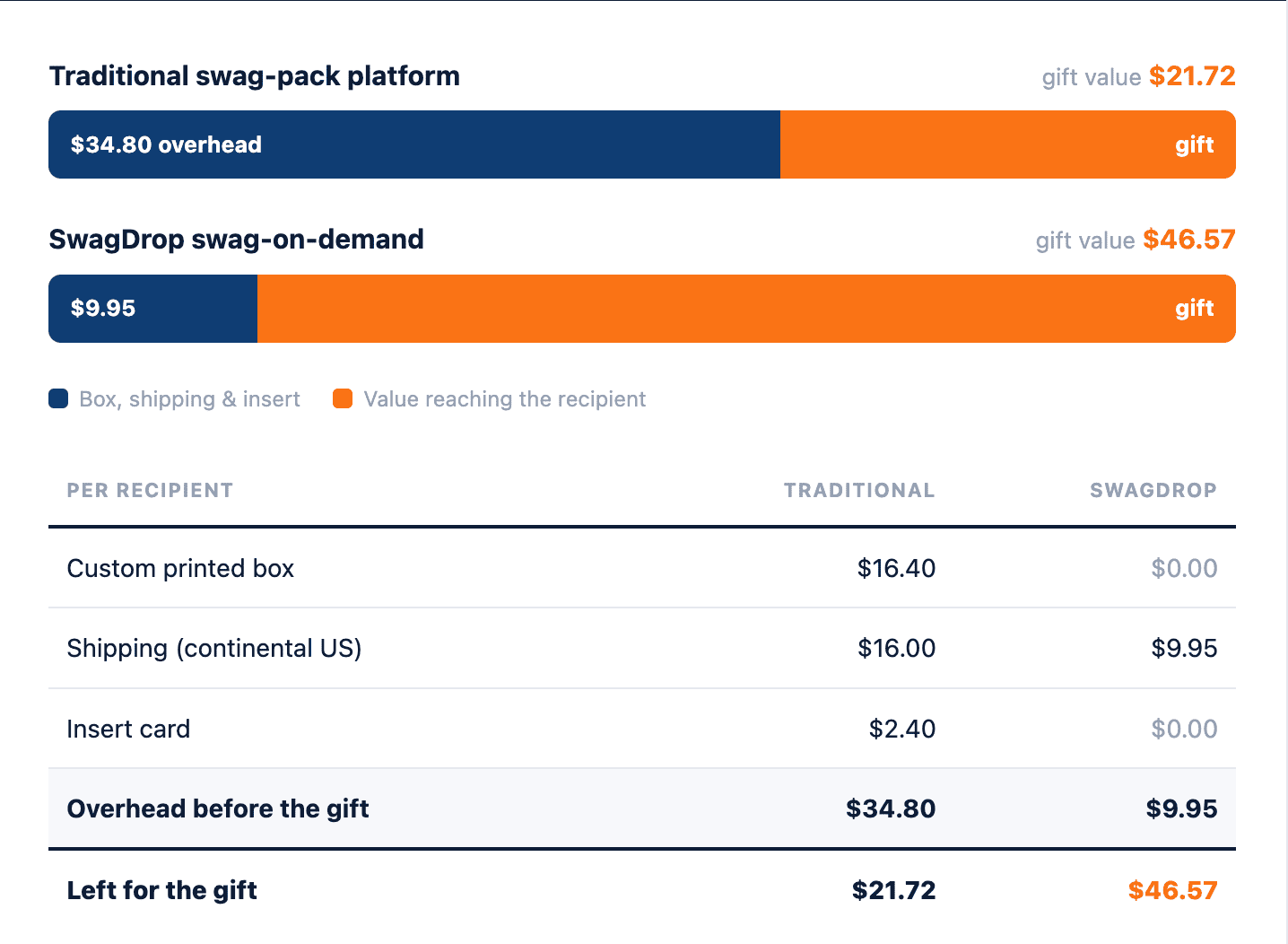
The breakdown was stark. Under the traditional swag-pack model, $34.80 of that $56 was consumed by overhead before a single product touched the employee’s hands: $16.40 for a custom printed box, $16.00 for continental US shipping, and $2.40 for an insert card. That left $21.72 for the actual gift, 38 cents of every dollar budgeted.
Under a swag-on-demand model, the only logistics cost was $9.95 per shipment. No custom box, no insert card, no kitting labor. That left $46.57 for the gift, 82 cents of every dollar budgeted.
Same $130,000 budget. $57,000 redirected out of packaging and into something employees keep.
The Three Layers of Budget Loss Nobody Budgets For In Inventory-Based Swag Programs
The comparison above covers direct logistics costs. But the bulk inventory model for employee programs creates three additional layers of budget erosion that rarely appear in the original proposal.
The First Is Dead Inventory and Unused Merchandise.
When you buy inventory upfront for a distributed workforce, you are guessing. You are guessing which sizes will be needed, how many people in each location will actually want the item, and whether the product itself will land well.
SwagDrop’s 2026 Employee Swag & Choice Gap Study, a Pollfish survey of 1,000 Canadian employees at companies with 250 or more employees, fielded May 2026, found that 73.7% of employees said the last piece of branded merchandise they received did not match what they would have chosen for themselves.
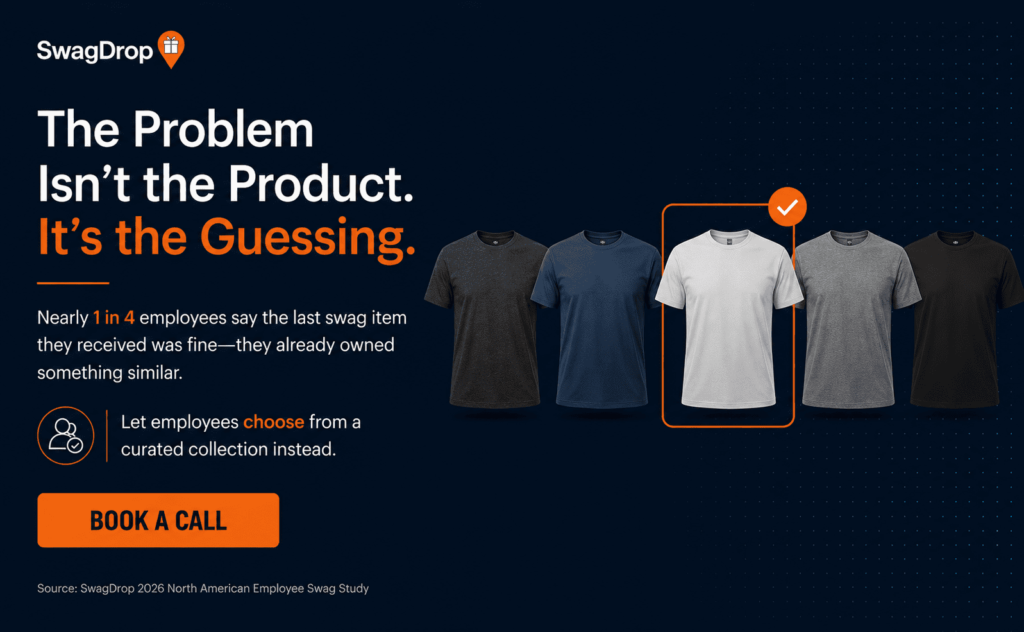
Nearly a third said they already owned something similar. That is not an individual preference gap. That is a systemic misalignment between what gets ordered and what people actually want, and every unit produced for an employee who would not have chosen it represents a budget that is permanently spent on nothing.
The Second Is Administrative Costs and Program Management
Running a bulk inventory program for employees does not end when the purchase order is placed. Someone has to collect addresses, usually via a Google Form or an email chain. Someone has to match those addresses to a shipping manifest. Someone has to track what went out, what was returned, and what is still sitting in the storage room. For a company-wide employee gift rollout on a fixed executive deadline, that administrative burden falls entirely on the HR or operations team, and it typically takes far longer than anyone planned.
The Third Is Unredeemed Swag and Wasted Budget.
With physical swag packs produced and shipped upfront, every unit is a spent dollar regardless of whether the employee wanted it. Employees move. Employees leave. Some employees, when honest, would rather receive nothing at all than a generic branded item, SwagDrop’s 2026 study found 5.3% of employees would opt out entirely if given the choice. In a bulk model, those are boxes that were produced, packed, shipped, and either returned or discarded. That is pure loss.
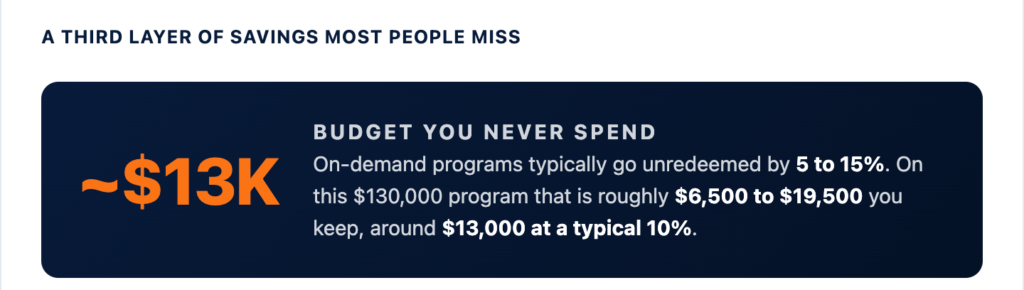
In a swag-on-demand model, an unredeemed budget is simply money that you keep. Programs typically see 5 to 15% non-redemption.
On a $130,000 program, that is $6,500 to $19,500 that rolls into the next program rather than into a recycling bin.
Apparel Creates Additional Inventory Challenges: Everything Compounds
The budget erosion described above accelerates when apparel is involved, which it almost always is.
Ordering hoodies, t-shirts, or jackets for a 1,000-person workforce requires HR to estimate the size distribution across the entire company. Some organizations pull from past order history. Some guess. Some run a quick survey and hope for a reasonable response rate.
None of these methods are reliable at scale, and the cost of getting it wrong shows up in two ways: sizes that run out frustrate employees who cannot get what they need, and sizes that overstock end up in a storage closet that someone eventually has to deal with.
In a store-based on-demand model, the employee selects their own size at checkout. Every item produced is the exact size the employee requested. There is no forecasting. There is no leftovers. The per-unit cost is the actual cost because every product produced was claimed by someone who wanted it.
Inventory-Based Swag vs Swag On-Demand: Which Delivers More Value?
The $57,000 gap in the comparison above did not come from choosing cheaper products. The product budget was identical. The gap came entirely from eliminating the overhead layer, the box, the insert, the freight structure, that the bulk model requires and the on-demand model does not.
| Cost Factor | Inventory-Based Swag Programs | Swag On-Demand Programs |
| Product Selection | Chosen by employer | Chosen by employee |
| Upfront Inventory Purchase | Required | Not required |
| Storage & Costs | Required | None |
| Size Forecasting | Required | Employee selects size |
| Dead Stock Risk | High | None |
| Address Collection | Managed by HR | Managed by employee |
| Kitting & Assembly | Required | Not required |
| Custom Packaging Costs | Often required | Typically eliminated |
| Unredeemed Budget | Already spent | Remains available |
| Shipping Model | Bulk shipment + distribution | Direct-to-employee fulfillment |
| Administrative Workload | High | Low |
| Budget Reaching the Product | Lower | Higher |
| Employee Satisfaction Potential | Variable | Higher due to choice |
| Budget Flexibility | Limited after purchase | High |
| Overall Cost Efficiency | Lower | Higher |
This is the part of the conversation that tends to reframe how companies think about the model choice. It is not about whether you can afford swag-on-demand. It is about recognizing that the bulk inventory model for employee programs is already spending a significant portion of the budget on things the employee never sees or touches.
A $50 per-employee budget in a swag-on-demand model produces a meaningfully better gift experience than a $50 per-employee budget in a bulk pack model, not because the products are different, but because more of the $50 reaches the product. The pay-per-claim budget structure reinforces this further: you only pay for items employees actually redeem, so the effective per-gift value improves even more when non-redemption is factored in.
How Swag On-Demand Maximizes Per-Employee Gift Value
The practical implication is that the model choice should happen before the budget conversation, not after it.
- If leadership has approved $75 per employee for a company-wide gift program and the plan is to run it as a bulk inventory model, a portion of that $75 is already committed to logistics before anyone has selected a product. The per-gift value the employee actually receives is lower than the number HR presented to finance.
- If the same $75 runs through a store-based on-demand model, nearly all of it reaches the product. The gift is better. The employee chose it. And because production only happens after redemption, sending swag to remote employees without collecting addresses manually is handled by the store itself, employees enter their own shipping details at checkout, regardless of where they are located across the US or Canada.
A vendor running a well-structured on-demand program should be able to walk you through this comparison with your actual numbers before you commit to either model. If they cannot show you where your budget goes, that is a signal worth paying attention to. For guidance on how to choose an enterprise swag vendor that can handle the operational and budget complexity of a distributed workforce program, the questions to ask center precisely on this: how much of my per-person budget reaches the gift?
What to Expect From a Vendor Who Runs This Model Well
Any vendor running on-demand employee programs at scale should offer:
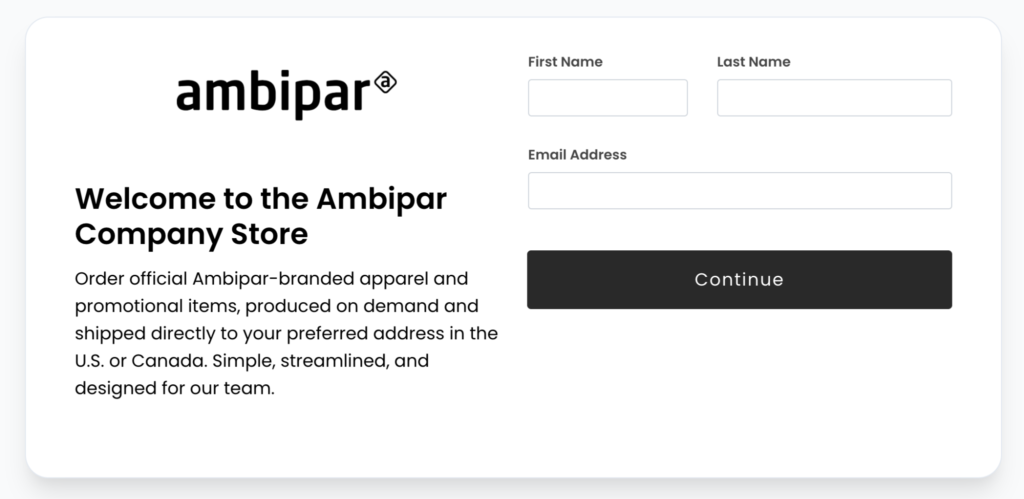
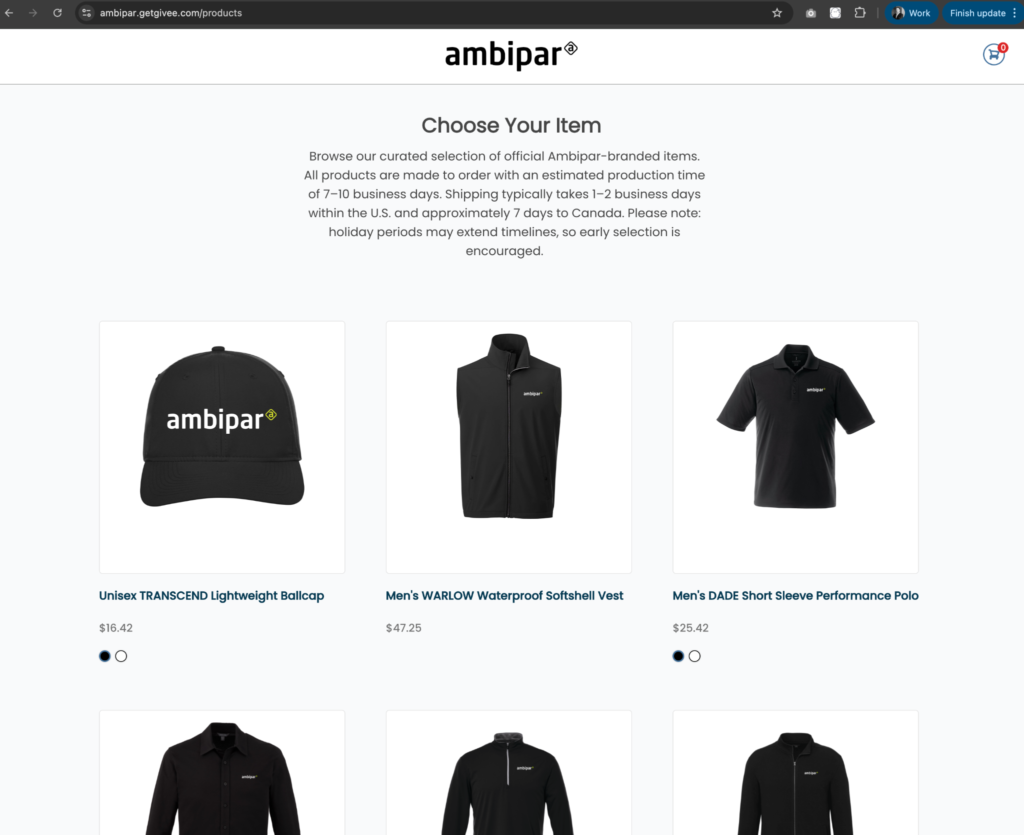
- Store-based redemption: Employees receive a link, select their item, choose their size, and enter their shipping address. No address collection by HR, no spreadsheet matching.
- Direct-to-employee fulfillment: Production and shipping happen without HR in the middle of the logistics chain.
- Domestic fulfillment in both the US and Canada: This is not optional for mixed workforces. Canadian employees receiving shipments from US warehouses face customs duties at their door, a cost that lands on the employee, not the program budget, and one that reflects poorly on the program. Cross-border swag mistakes in this area are entirely avoidable.
- Real budget transparency: You should be able to see, before committing, exactly how much of your per-person budget reaches the product under each model. If that comparison is not offered proactively, ask for it.
How SwagDrop Runs On-Demand Swag Programs
SwagDrop provides a white-glove, managed swag program built precisely around the on-demand, store-based model. We help companies with 500 to 5,000 employees eliminate the waste of inventory forecasting and transition into a streamlined, employee-driven experience.
SwagDrop has been running store-based, on-demand programs since 2008, years before purpose-built swag platforms existed.
One of our earliest was for TD Bank: a bilingual online store built, tested, and launched in under one week, enabling 1,102 branches across Canada to order size-specific T-shirts for 22,000 branch employees. The result was a 25%+ reduction in order volume versus the original bulk estimate, with zero dead stock.
“He always comes to the table with great ideas, quality products and a willingness to meet constraints and deadlines.”, Mary Desjardins-Therrin, Executive Director, TD Friends of the Environment Foundation, TD Bank (8 years, 8 months, Greater Toronto Area), LinkedIn recommendation for Mark Jackson, President, SwagDrop, October 19, 2010
You Define It, We Run It
SwagDrop is not a SaaS platform. We are a promotional products company with over 30 years in the industry that uses technology to make your program easier to run, not to add another software subscription to your budget. There are no seat fees, no license fees, no platform charges, no contract. You pay for the product and the shipping. That’s it. You tell us the goals, the audience, and the per-employee budget. We build the store, curate the products, and manage everything from production through direct-to-employee fulfillment.
Opinionated Guidance from 30+ Years of Experience
We don’t just take orders, we provide opinionated guidance from our institutional knowledge. With over three decades of experience in branded merchandise, we tell our clients what works and what doesn’t. We know which items thrive in an on-demand environment, how to structure your catalog to maximize redemptions, and how to avoid common operational pitfalls.
In-Country Fulfillment by Default
SwagDrop routes US employee orders to US facilities and Canadian employee orders to Canadian facilities. This ensures that every shipment is treated as a domestic delivery. By eliminating cross-border freight, we guarantee your Canadian employees receive a premium experience free of unexpected duties at the door.
If you want to run the same comparison for your program numbers, book a call with Mark.
Frequently Asked Questions
How much of a swag budget actually reaches the employee in a bulk inventory program?
In a typical bulk swag-pack model, a significant portion of the per-person budget is consumed by logistics before the employee touches a single product. SwagDrop ran this comparison for a real client: on a $56.52 per-person budget, $34.80 went to a custom printed box, continental US shipping, and an insert card, leaving $21.72 for the actual gift. That is 38 cents of every budgeted dollar reaching the product. In SwagDrop’s swag-on-demand model, the only logistics cost is a flat $9.95 per shipment, leaving $46.57 for the gift, 82 cents of every dollar.
What happens to the budget when employees don’t redeem their swag?
In a bulk inventory model, every unit is produced and shipped upfront, so the budget is fully spent regardless of whether an employee wanted the item or not. In SwagDrop’s on-demand model, production only happens after an employee redeems through the store. Programs typically see 5 to 15% non-redemption, which means that share of the budget is never drawn down. On a $130,000 program, that is $6,500 to $19,500 that rolls into the next program rather than into a recycling bin.
Why does bulk ordering work for conferences but not for employee swag programs?
Bulk ordering is rational when the quantity is fixed and every recipient receives the same item, conferences, trade shows, and product launches with a defined headcount fit this model well. Employee swag programs are structurally different: the workforce is distributed, sizes are unknown, and employees may not want what has been chosen for them. SwagDrop’s 2026 Employee Swag & Choice Gap Study found that 73.7% of employees said the last piece of branded merchandise they received did not match what they would have chosen for themselves. That misalignment is what makes the bulk inventory model expensive for employee programs specifically, dead stock, size overruns, and administrative overhead compound the base logistics cost.
When should the model choice, bulk inventory vs. swag on-demand, happen in the budget process?
The model choice should be made before the per-employee budget is presented to finance, not after. In a bulk inventory program, a portion of the approved budget is already committed to logistics, packaging, kitting, freight, before any product is selected. That means the number HR presents to leadership overstates the actual gift value. SwagDrop recommends running the budget comparison against your specific program numbers first, so the per-person gift value is accurate and the model choice is grounded in what actually reaches the employee.
How does SwagDrop handle sizing for apparel without requiring HR to forecast?
SwagDrop’s store-based on-demand model eliminates size forecasting entirely. Employees access a branded store, select the item they want, whether that is a hoodie, t-shirt, jacket, or any other apparel, and enter their own size at checkout. Production only begins after that selection is made, so every item manufactured is the exact size the employee requested. There is no inventory to overstock, no sizes that run out, and no HR team managing a size survey across a distributed workforce.