

In short: On-demand swag means items are produced only after an employee chooses them: no forecasting, no bulk orders, no storage, and no unused inventory.
When enterprise teams of 500 to 5,000 employees encounter logistical bottlenecks with their corporate merchandise, the instinct is often to look for better shipping software or a new warehouse. But the friction is rarely just a shipping issue; it is a structural problem with how the merchandise is sourced and stored.
Understanding on-demand swag requires a complete mindset shift regarding how corporate goods are produced. It is the transition from buying inventory upfront to producing items only when they are actively claimed.
The Breakdown: At A Glance
As HR and Internal Comms teams look to modernize their employee gifting and recognition programs, a specific term keeps surfacing during vendor evaluations and budget meetings. Leaders are asking what is on-demand swag, and more importantly, how does it differ operationally from what they are currently doing?
| Traditional Inventory Model | On-Demand Swag Model |
| Buy thousands of units upfront | No pre-purchased inventory |
| Guess sizes, colors and quantities | Employees choose exact size and item |
| Requires storage & manual handling | Nothing stored; items created on demand |
| Bulk shipments via a HQ | Direct-to-employee shipping |
| High waste, unused stock | Zero waste, only produce claimed items |
| Cross-border duties for Canada | Domestic fulfillment in both countries |
The Traditional Inventory Trap
To truly understand the value of an on-demand system, you first have to look at the traditional alternative: the inventory-based model.
Historically, if a company wanted to roll out new gear for an all-hands meeting or a company-wide recognition campaign, they approached it with an inventory mindset. They would determine they needed “$40,000 worth of inventory.” HR would issue a purchase order, guessing at the size breakdown for thousands of employees, and pay for the goods upfront.
This inventory-first approach fails modern, distributed workforces in three distinct ways:
- Financial Waste: You pay for items before you know if anyone wants them. If you miscalculate the need for a specific size or color that inventory sits in a storage closet as dead stock.
- Logistical Burden: Someone has to store, manage, pack, and ship those physical goods from a central location.
- Cross-Border Failures: When you ship pre-purchased inventory from a US warehouse to employees in Canada, it triggers customs inspections. Canadian employees are frequently slapped with surprise duties and taxes at their front door just to receive a corporate gift.
The Model Shift: Zero Inventory, Employee Choice
So, what is on-demand swag?
At its core, it is a store-based model where merchandise is only produced after an employee specifically selects it.
There is no pre-purchasing of stock. No pre-buying inventory. No warehouse. No closets full of unused goods.
Instead of pushing an identical, pre-ordered item onto the entire workforce, the company curates an approved catalog of high-quality products. Eligible employees receive an invite link to an internal company store. They browse the collection, choose the item they actually want, select their precise size, and enter their current home address.
Research that PRG – Promotion Resource Group(now SwagDrop) commissioned with Advanis in 2006 found that 73% of branded merchandise recipients said they were more likely to do business with the gift presenting company, but only when the item resonated. The on-demand model exists precisely to close the gap between what companies order and what employees actually want to receive.
Two decades later, the same gap has been measured directly from the Canadian employee’s side for the first time.
According to SwagDrop’s 2026 Employee Swag & Choice Gap Study — a Pollfish survey of 1,000 Canadian employees at companies with 250 or more employees, fielded May 2026 — nearly 3 in 4 employees (73.7%) said the last piece of branded merchandise they received from their employer did not match what they would have chosen for themselves. Only 26.3% said it was exactly what they would have picked. The study is the first large-scale Canadian dataset to measure the employee experience of corporate branded merchandise programs from the recipient’s perspective.
The same logic applies internally. Employees who receive something they actually wanted are far more likely to wear it, use it, and feel like the company actually knows them.
The act of choosing becomes the experience and the budget only funds actual engagement.
Only at that exact moment does the item go into production. This flips the model from a “push” to a “pull,” ensuring your budget is spent entirely on active engagement with zero wasted inventory.
A Quick Scenario (This Makes It Click)
A 2,000-person company placing a bulk order for hoodies must guess the size curve and absorb leftover risk. With on-demand, only the 1,847 employees who choose a hoodie trigger a purchase. The remaining budget never leaves HR’s account; no waste, no storage, no guesswork.
“Nearly half of Canadian employees at large organizations never received a welcome kit when they started. Of those who did, fewer than 1 in 4 said it made them feel genuinely valued.”
— SwagDrop Employee Swag & Choice Gap Study, Canada, n=1,000, May 2026
The on-demand model exists precisely to close this gap — ensuring that every item produced is one an employee actively chose, in the right size, shipped directly to their door.
Operating an On-Demand Program: A Quick View
Moving from an inventory-heavy model to a sleek, on-demand operation requires a shift in how you manage the program. Here are the concrete steps HR and Operations teams take to run this successfully:
1. Shift to a Program-Based Budget
Stop issuing purchase orders for thousands of units. Instead, define a per-employee budget ceiling for a specific campaign (e.g., $50 per employee for a rebrand rollout). You only commit capital when an employee actually redeems their gift.
2. Set the Catalog Guardrails
Work within your approved budget to select a tight, curated collection of items. Offering 5 to 10 high-quality choices, like premium drinkware, apparel, and bags, prevents choice paralysis while still giving the employee agency over their gift.
3. Use the Invite Link as the Gift Moment
Because items are produced on-demand, you won’t have physical boxes to hand out on launch day. Instead, anchor the celebration around the invitation. The moment the store link hits the employee’s inbox, the psychological impact of the gift is delivered. The act of choosing is the experience.
One more thing worth knowing: if an employee wants to go beyond their allocated credit, they can. SwagDrop’s Stripe integration allows employees to top up with their own payment at checkout — no friction, no separate process. In our experience, roughly 30% of employees choose to spend beyond their credit, which says something worth noting: when people are given a selection they actually want, they will pay out of their own pocket to get more of it.
What to Expect from an On-Demand Vendor
To execute this without adding administrative overhead, you need a vendor built specifically for zero-inventory operations. Any partner you consider should offer:
- Store-Based Workflows: The ability to spin up an employee-facing store where users can check out using pre-approved credits.
- True On-Demand Production: The operational capacity to produce single items as orders flow in, without forcing you into arbitrary minimums.
- Direct-to-Employee Shipping: Moving parcels straight from the production floor to the recipient’s home address, bypassing your office entirely.
- Domestic Fulfillment Networks: Confirmed production capabilities within both the US and Canada to ensure orders never cross the border, preventing surprise duties.
How SwagDrop Runs On-Demand Swag Programs
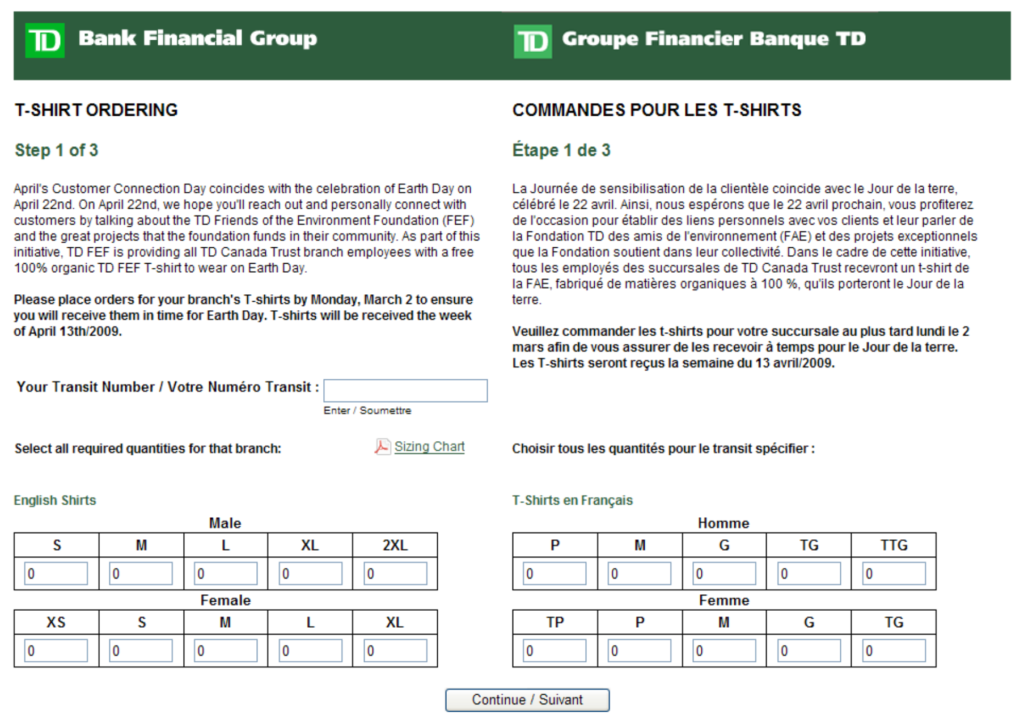
SwagDrop has been running store-based, on-demand programs since 2008 — years before purpose-built swag platforms existed. One of our earliest was for TD Bank: a bilingual online store built, tested, and launched in under one week, enabling 1,102 branches across Canada to order size-specific T-shirts for 22,000 branch employees. The result was a 25%+ reduction in order volume versus the original bulk estimate, with zero dead stock.
SwagDrop provides a white-glove, managed swag program built precisely around the on-demand, store-based model. We help companies with 500 to 5,000 employees eliminate the waste of inventory forecasting and transition into a streamlined, employee-driven experience.
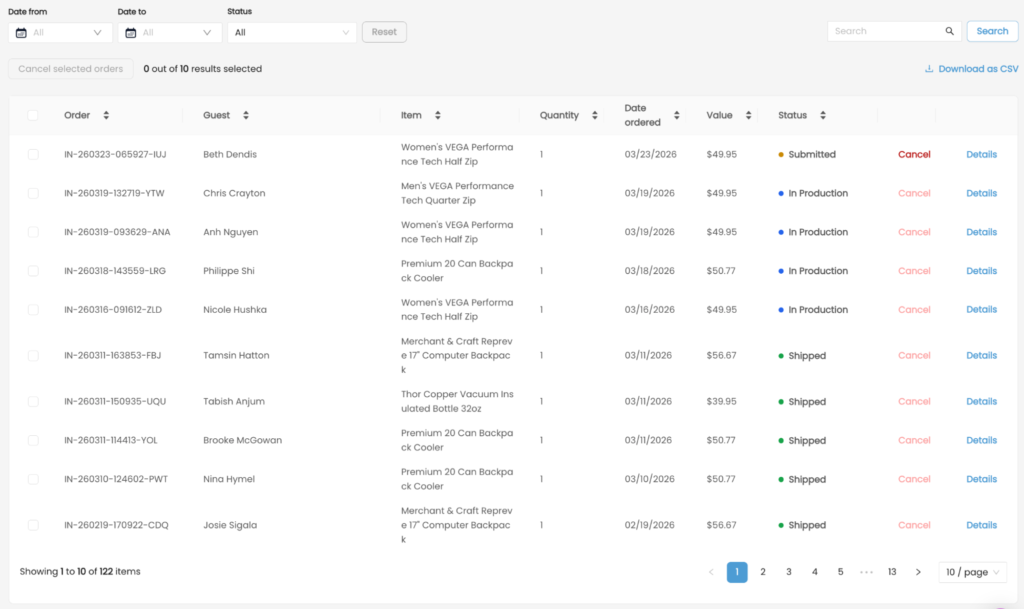
View of current Swag On Demand production dashboard.
More recently, SwagDrop built and manages the on-demand company swag store for the Better Business Bureau’s 2026 North American rebrand — a rollout covering more than 100 offices across the United States and Canada. “As part of BBB’s brand reimagination, a curated collection of newly branded merchandise is now available to your office. Browse the selection and choose the items that best support your local outreach.” — Better Business Bureau, On-Demand Company Swag Store (powered by SwagDrop), 2026 North American rebrand, 100+ offices, US and Canada. The result: zero obsolete inventory, instant catalog updates when brand assets change, and no cross-border duty exposure for Canadian offices.
You Define It, We Run It
SwagDrop is not a SaaS platform. We are a promotional products company with over 30 years in the industry that uses technology to make your program easier to run, not to add another software subscription to your budget. There are no seat fees, no license fees, no platform charges. You pay for the product and the shipping. That’s it. You tell us the goals, the audience, and the per-employee budget. We build the store, curate the products, and manage everything from production through direct-to-employee fulfillment.
Opinionated Guidance from 30+ Years of Experience
We don’t just take orders, we provide opinionated guidance from our institutional knowledge. With over three decades of experience in branded merchandise, we tell our clients what works and what doesn’t. We know which items thrive in an on-demand environment, how to structure your catalog to maximize redemptions, and how to avoid common operational pitfalls.
In-Country Fulfillment by Default
SwagDrop routes US employee orders to US facilities and Canadian employee orders to Canadian facilities. This ensures that every shipment is treated as a domestic delivery. By eliminating cross-border freight, we guarantee your Canadian employees receive a premium experience free of unexpected duties at the door.
On a Concluding Note
The transition to on-demand swag is ultimately about eliminating the financial and operational waste of holding physical inventory. By adopting a store-based model where items are produced only after they are claimed, HR teams can stop guessing sizes, close the storage closet for good, and deliver a personalized gifting experience that employees actually value.