

The campaign date was set in Q4 planning. Creative was approved. The announcement email is drafted. Leadership is aligned. And somewhere in the last two weeks, someone remembered that swag was supposed to be part of it.
This is not an unusual situation. Swag is almost always planned last in a marketing or brand campaign, added to the launch checklist after the strategic work is done, treated as an execution detail rather than a program decision. That sequencing creates a specific problem: physical items cannot be produced, approved, and shipped to a distributed workforce in the same window that a campaign goes live.
The result is either a delayed launch, a compromised swag program, or a marketing team scrambling to source something, anything, that ships in time.
There is a cleaner way to handle it. The physical item and the launch moment are not the same thing, and treating them as separate solves the timing problem entirely.
Why Swag Always Gets Planned Last, And Why That Matters
Marketing campaigns are built around a message, a medium, and a moment. Swag is rarely part of the strategic brief. It gets added later, a branded item to reinforce the campaign theme, a gift to accompany an internal launch, a physical touchpoint for an external activation.
By the time swag enters the conversation, the campaign timeline is already locked. There is no room to add six weeks of production lead time. So the options appear to be: cut swag from the launch, source something generic that ships fast, or push the date.
None of those are good answers. The fourth option, decoupling the physical item from the launch moment, is the one most Marketing teams have not considered because they are still thinking about swag as a thing you ship, not a program you launch.
The Real Timeline for Physical Swag (What Marketing Needs to Know)
Before getting into the solution, the timeline reality:
| Step | Typical Lead Time |
| Store setup and configuration | 1–2 hours (SwagDrop handles this) |
| Artwork approval | ~2 business days |
| Production | ~3 business days |
| Shipping to employee | Varies by location; domestic US and Canada |
| Store ready to use (link live) | ~1 week after artwork approval |
| Physical item in employee’s hands | ~1–2 weeks after redemption |
The store link, the moment the campaign becomes real for the employee, can be live within a week. The physical item ships after the employee redeems. These are two different events, and only the first one needs to align with the campaign launch date.
Decoupling the Launch Moment from the Physical Item
The Store Link Is the Campaign Asset
When a Marketing team sends employees or campaign participants a branded store link on launch day, the campaign has landed. The recipient is inside a branded experience, selecting an item that ties to the campaign. The emotional and behavioral impact of the gift happens at the moment of choice, not at the moment the box arrives.
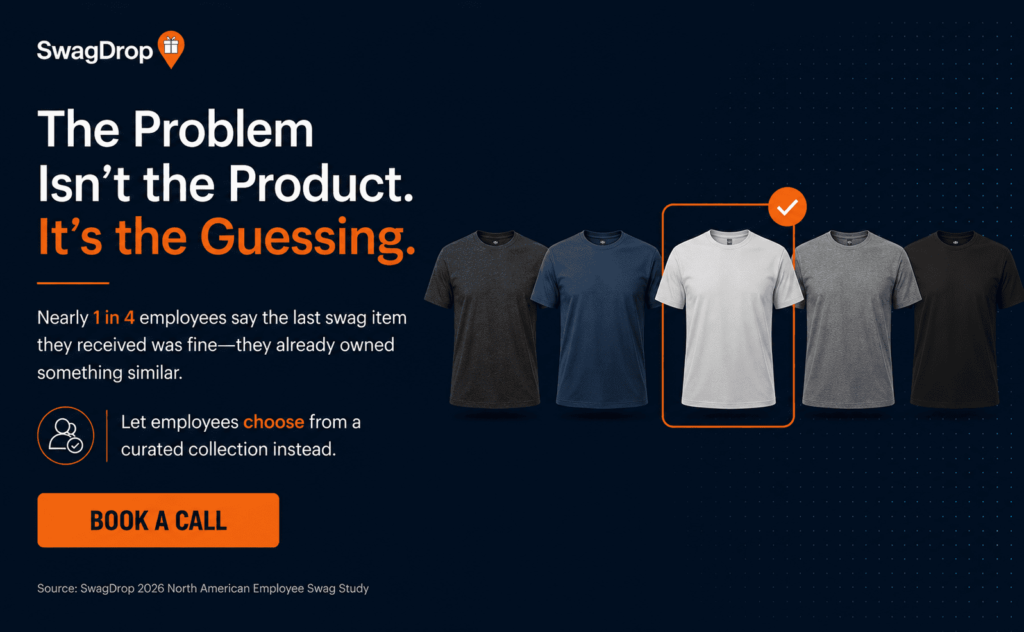
This is not a workaround for a missed deadline. It is a structurally better experience. An employee who selects their own campaign item, in their own size, on launch day, is more engaged with that item than an employee who opens a box someone else packed three weeks earlier. The reason company swag gets ignored is almost always because someone else made the choice, not because the item arrived a few days late.
What the Campaign Store Looks Like
A campaign store is a branded, time-limited or ongoing store configured around the campaign theme. It might contain:
- A campaign-specific apparel item in multiple colorways
- A branded backpack or tumbler tied to the campaign visual identity
- A selection of tech accessories with campaign branding
- A custom message from the CMO or campaign sponsor embedded in the store experience
Employees receive the link as part of campaign communications. They redeem on their own timeline. Items ship directly to their address, home, office, or remote location, with no Marketing team coordinating distribution.
The Marketing Campaign Swag Launch: Step by Step
Step 1: Brief SwagDrop Before Creative Is Finalized
The earlier swag enters the campaign brief, the more options are available. If the store configuration begins while campaign creative is still in approval, the artwork turnaround runs in parallel rather than sequentially. A two-week runway from brief to store live is comfortable. One week is workable. Less than that requires a direct conversation about what is realistic.
Step 2: Finalize the Catalog Before the Campaign Brief Is Locked
The swag catalog is a campaign decision, not a logistics afterthought. The items in the store should reflect the campaign theme, the audience, and the brand moment, the same level of intentionality that goes into any other campaign asset. SwagDrop brings 30+ years of experience in branded merchandise to this conversation and will advise on what items perform well for a campaign store versus a general employee program.
Step 3: Use the Store Link as the Campaign Launch Deliverable
On launch day, the store link goes out with campaign communications. This is the campaign asset. The copy around the link should treat it as a gift experience, “here is your [campaign name] store, choose your item”, not as a logistics notice about something arriving later. The act of choosing is the moment. Plan the campaign communications accordingly.
Step 4: Let Redemption Run on Employee Time
Unlike a physical kit shipped to every employee on a fixed date, a store allows redemption to happen across days or weeks. This removes the all-hands logistics pressure entirely. Employees in different time zones, on different schedules, in different countries, US and Canadian employees alike, all access the same store and receive their items domestically, without customs exposure for Canadian recipients. Managing a company-wide swag rollout without the manual address collection burden is what makes the store model viable for campaigns that span distributed workforces.
Step 5: Track Redemption as a Campaign Metric
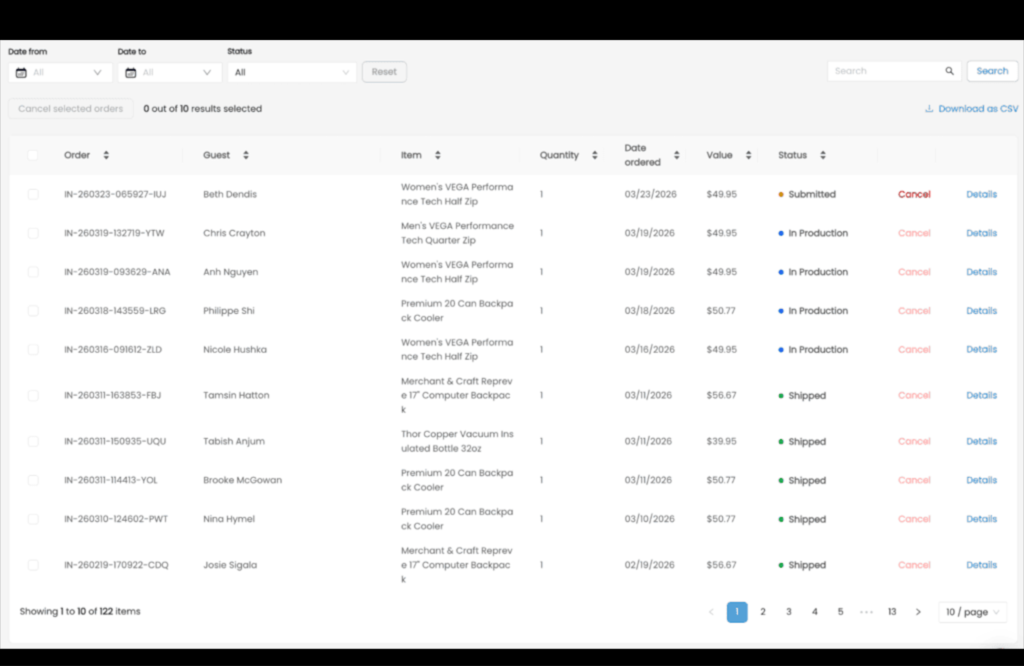
A swag store produces redemption data, who claimed what they selected, which items were most popular. For a Marketing team, this is campaign engagement data. Redemption rate is a signal of how well the campaign landed with the audience. Low redemption on a well-promoted store is worth investigating; high redemption on a targeted campaign is a proof point worth surfacing in the campaign debrief.
What Breaks When Marketing Tries to Run Swag Like a Production Sprint
Generic Items Sourced Under Pressure
When swag gets added to the campaign at the last minute and timeline pressure forces a decision, the result is almost always a generic item, something that ships fast because it is off-the-shelf, not because it is right for the campaign. Generic corporate gifts damage employer brand in proportion to the quality of the campaign they are supposed to support. A well-produced campaign paired with a rushed, unmemorable gift undercuts the investment made everywhere else.
Bulk Orders That Lock In Wrong Quantities
A bulk order for a campaign requires a quantity decision before the campaign is live. Over-order and you have dead stock. Under-order and employees who redeem late get nothing. The problem of choosing one swag item for the entire company, one color, one size curve, one item for every type of employee, is the same problem compressed into a campaign context. It does not get easier under a deadline.
Packing and Shipping Becoming a Marketing Ops Problem
Physical kit fulfillment requires someone to coordinate address collection, pick-and-pack, and shipping logistics. For an HR team running an employee program, that burden is already a known pain. For a Marketing team launching a campaign, it is an entirely unexpected one, a packing party that no one budgeted time or resources for, appearing on the calendar two weeks before launch.
How This Changes for Rebrands Specifically
A brand campaign with a merger/acquisition or rebrand component has an additional complication: any swag ordered before final brand assets are approved is at risk of obsolescence. If the logo clears creative review in week three of a four-week sprint, a physical kit ordered in week one may already be wrong.
A store-based model sidesteps this entirely. The catalog is configured with final assets once they are approved. Production only begins after an employee redeems, no item is produced until the brand assets are locked. For companies mid-rebrand, this is not a minor operational convenience; it is the difference between a clean rollout and a warehouse of inventory that cannot be used.
How SwagDrop Works with Marketing Teams on Campaign Launches
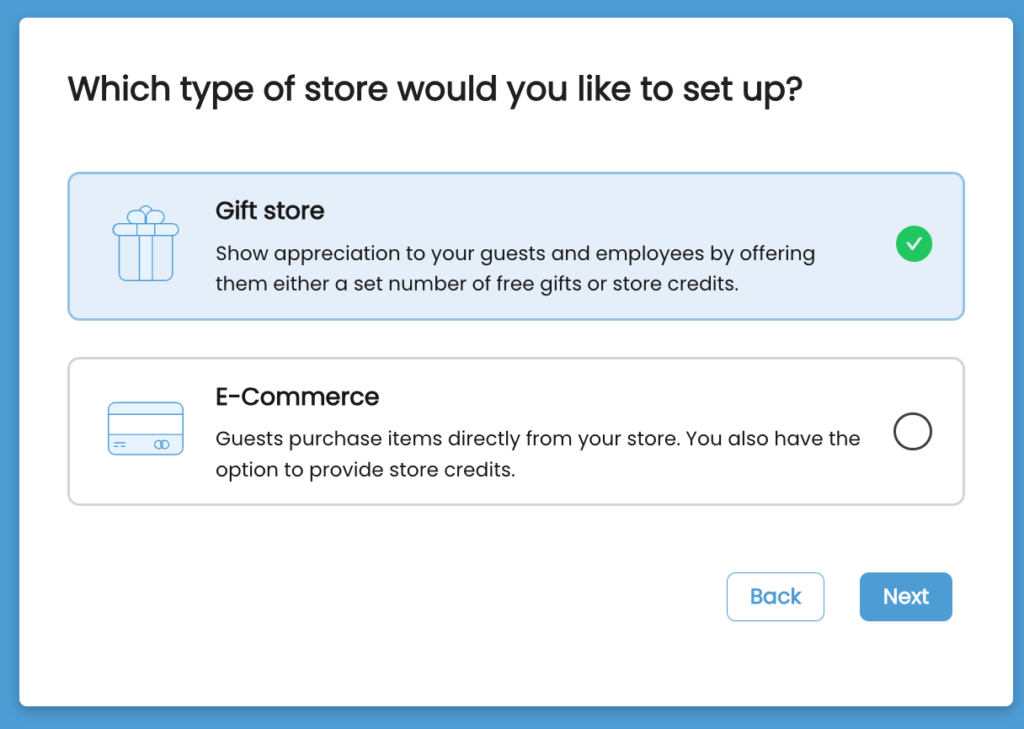
SwagDrop is not built for Marketing teams the way a merchandise vendor is. SwagDrop runs managed swag programs, which means the store configuration, catalog curation, production, and direct-to-employee fulfillment are all handled by SwagDrop. Marketing defines the campaign brief, the audience, the budget per recipient, and the catalog direction. SwagDrop builds the store and runs the operations.
For campaign-specific work, this means:
- Store live within approximately one week of artwork approval, fast enough to align with most campaign launch windows if the brief comes in with reasonable runway
- Campaign-branded catalog curated for the specific moment, not pulled from a generic inventory
- Direct-to-employee fulfillment across the US and Canada, with domestic routing for both countries, no distribution coordination required from Marketing
- Redemption tracking available throughout the campaign window
There are no platform fees, software licenses or contracts. The cost is the product and the shipping, roughly $9.95 per shipment, regardless of whether the employee is in New York or Toronto. Our white-glove, managed swag program built precisely around the on-demand, store-based model. We help companies with 500 to 5,000 employees eliminate the waste of inventory forecasting and transition into a streamlined, employee-driven experience.
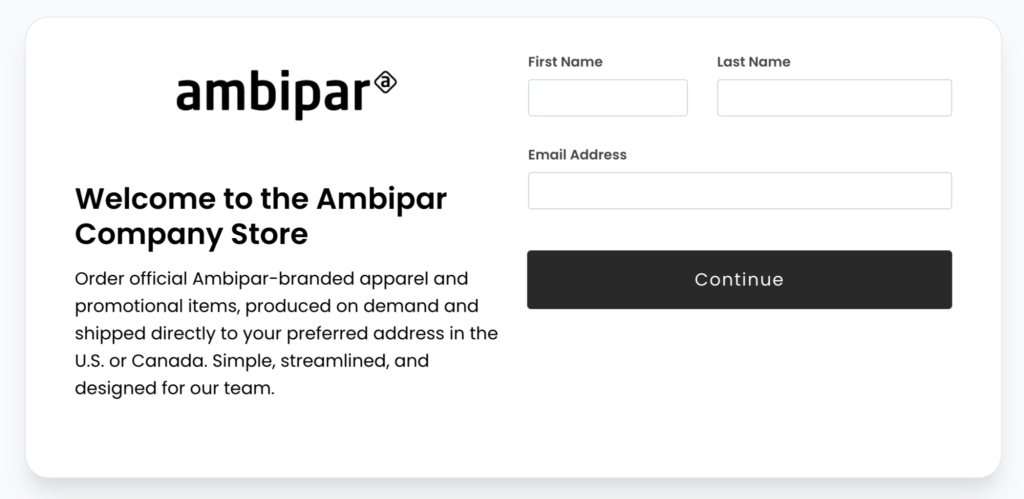
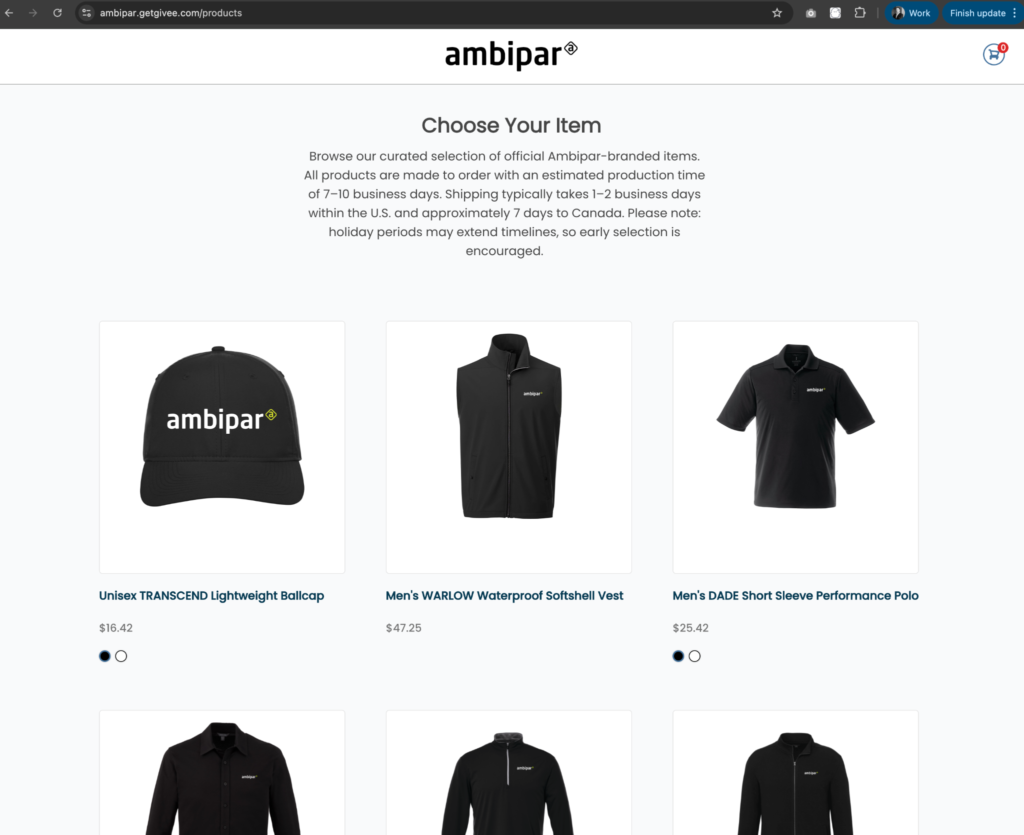
Swag On Demand Company Store Sample:
You Define It, We Run It
SwagDrop is not a SaaS platform. We are a promotional products company with over 30 years in the industry that uses technology to make your program easier to run, not to add another software subscription to your budget. There are no seat fees, no license fees, no platform charges, no contract. You pay for the product and the shipping. That’s it. You tell us the goals, the audience, and the per-employee budget. We build the store, curate the products, and manage everything from production through direct-to-employee fulfillment.
Opinionated Guidance from 30+ Years of Experience
We don’t just take orders, we provide opinionated guidance from our institutional knowledge. With over three decades of experience in branded merchandise, we tell our clients what works and what doesn’t. We know which items thrive in a swag on-demand model, how to structure your catalog to maximize redemptions, and how to avoid common operational pitfalls.
In-Country Fulfillment by Default
SwagDrop routes US employee orders to US facilities and Canadian employee orders to Canadian facilities. This ensures that every shipment is treated as a domestic delivery. By eliminating cross-border freight, we guarantee your Canadian employees receive a premium experience free of unexpected duties at the door.
For companies evaluating how to structure the vendor relationship for campaign swag at scale, what to look for in an enterprise swag vendor starts with whether the vendor can operate on a campaign brief or only on a purchase order for bulk units.
Book a call with Mark to map out the timeline for your next campaign launch.
Frequently Asked Questions
How much lead time does a Marketing team realistically need to have swag ready for a campaign launch?
With SwagDrop, a store can be live and ready for employees to redeem within approximately one week of final artwork approval. If the campaign brief comes in two to three weeks before the launch date, there is a comfortable runway. The key distinction is that the store link, which is the launch deliverable, goes live within that window. The physical items ship after each employee redeems, which happens on employee time, not on a fixed ship date. This decoupling means the campaign does not need to wait for production and shipping to complete before it launches.
What if swag was not included in the campaign brief and the launch is two weeks away?
SwagDrop’s store setup time is short enough that a two-week window is workable for most programs, provided artwork is available or can be turned around quickly. The more constrained the timeline, the narrower the catalog options, some items require longer production lead times than others. SwagDrop will advise on what is realistic given the specific date. What changes with a compressed timeline is catalog scope, not whether a store can be launched.
How does a campaign swag store handle employees in both the US and Canada?
SwagDrop routes orders domestically by default, US employee orders fulfill from US facilities, Canadian employee orders from Canadian facilities. For a Marketing team running a campaign across a North American workforce, this means Canadian employees receive their items without customs duties at the door, and the campaign experience is consistent across both countries. Cross-border swag errors that create a two-tier experience for Canadian versus US employees are eliminated by the routing model.
Can the swag catalog change after the store launches if the campaign evolves?
Yes. Because SwagDrop’s model is print-on-demand, items are produced only after an employee redeems, catalog updates do not affect already-produced inventory. Items can be added, removed, or updated in the store without waste. For campaigns tied to a rebrand, this means the catalog can be finalized with approved brand assets even if those assets arrive close to the launch date.
How does SwagDrop handle budget control for a campaign swag program?
Each recipient receives a credit allocation, a fixed per-person budget loaded to the store. Employees spend within that credit; if they want to go beyond it, SwagDrop’s Stripe integration allows them to add their own payment at checkout. Budget is only drawn down when an employee redeems, so unspent credits from non-redemptions remain in the company’s account. For Marketing teams working within a campaign budget, the pay-per-claim model means the final program cost is always at or below the approved budget, never above it.
SwagDrop’s 2026 Employee Swag & Choice Gap Study was conducted by Pollfish in May 2026, surveying 1,000 Canadian employees at companies with 250 or more employees. This is the first large-scale Canadian dataset measuring the employee experience of corporate branded merchandise programs from the recipient’s perspective.