


There is a version of this story that ends with a help desk ticket. A gift was ordered. The employee never received it. HR follows up with the vendor. The vendor follows up with the carrier. The carrier confirms the address was invalid. By the time anyone figures out what happened, the moment the gift was meant to mark, be it a work anniversary, a new hire’s first week, or a company-wide milestone, has passed.
The undelivered swag problem looks like a logistics failure. In most cases it is a program design failure that was always going to produce this outcome.
The Failure Almost Never Starts With The Carrier
When a swag shipment goes undelivered, the instinct is to treat it as a fulfillment problem. Wrong carrier. Bad tracking. Slow transit. Those things happen, but they are rarely the root cause at scale.
In programs we manage for companies with hundreds to several thousand employees, the pattern is consistent: by the time a shipment fails, the actual problem was set in motion weeks or months earlier, during program design. The carrier is just where the consequence surfaces.
The Actual 4 Key Drivers Behind Swag Delivery Failure
The upstream failures tend to cluster around four conditions. Most programs that produce high undeliverable rates have at least two of them operating simultaneously.
Failure Condition 1: Address Data That Was Never Collected Directly From The Employee
The most common source of undeliverable swag is address data that came from somewhere other than the employee themselves.
HR exports a list from the HRIS. Someone pulls the last known address from onboarding paperwork. A manager submits a spreadsheet on behalf of their team. All of these approaches share the same flaw: the address was accurate at some point, but nobody verified it is accurate now.
Employees move. Remote workers especially. A study by the U.S. Census Bureau found that Americans move at a rate of roughly one in eight per year — and remote workers, freed from commute proximity, move more frequently than office-based staff. An address collected at hire and never updated has a meaningful chance of being wrong by the time a gift ships, even twelve months later.
The correct model is to collect the shipping address from the employee, at the moment of the program, for that specific shipment. Not from a system record. Not from a manager. From the person receiving the gift, as part of their redemption experience.
This is one of the reasons a store-based program — where employees enter their own address when they claim their gift — produces materially lower undeliverable rates than a program where HR batch-submits addresses on behalf of the workforce. The employee has every incentive to enter their current address correctly. A two-year-old HRIS record has no such incentive.
Failure Condition 2: A Single-Point-Of-Failure Address Collection Process
Even when a program does ask employees to provide their address, many programs funnel that collection through a single mechanism — a reply-to email, a Google Form, a Slack message to a channel. Any single-mechanism collection process has obvious failure modes: employees miss the message, ignore it, respond to the wrong thread, or enter an address that gets transcribed incorrectly when someone on the HR team manually copies it into a spreadsheet.
The better design is to put address collection inside the redemption flow itself, so that providing an address is a required step before an order can be placed, rather than a separate administrative task that can be skipped, lost, or mangled in transit between systems.
When address collection is embedded in the order flow, the completion rate for valid address submission is structurally higher — not because employees are more diligent, but because the program architecture makes it impossible to complete the redemption without completing that step.
Failure Condition 3: No Mechanism To Catch Bad Addresses Before Orders Are Placed
Many swag programs ship to whatever address is in the system at order time, with no validation step between address submission and production. An employee submits “123 Main St, Anytown” with no zip code. The order ships. It fails. HR finds out three weeks later when the employee asks where their gift is.
Address validation — checking that a submitted address is a real, deliverable postal address before an order enters production — is a basic quality control step that many legacy swag programs do not have.
This is partly a vendor capability gap. Traditional promotional products suppliers were built for bulk orders shipped to corporate offices. They were not designed for direct-to-employee fulfillment at scale, and many of their systems do not include address validation tooling. When a program requires hundreds or thousands of individual addresses to be validated and shipped to, those systems simply were not built for it.
Programs that use a purpose-built employee store model, with integrated address entry and validation at the point of redemption, catch the majority of address problems before anything ships rather than after.
Failure Condition 4: Legacy Vendor Infrastructure Not Built For Direct-To-Employee Fulfillment
This is the condition that the first three often trace back to.
A legacy promotional products supplier — the kind of vendor a company may have worked with for five, ten, or twenty years — was designed for a different operating model. They take a bulk order, print or produce it, and ship a pallet to a corporate address. HR distributes from there. The vendor’s job ends at the loading dock.
That model works for events and uniform distributions. It does not work for a distributed workforce where every shipment has a different destination.
When companies try to run a direct-to-employee gifting program through a vendor built for bulk, the friction shows up in specific ways:
- Address management is manual on both sides. The vendor has no system for collecting or storing individual employee addresses. HR maintains the list. Every update requires HR to resubmit. Every error is HR’s responsibility to catch.
- Order minimums conflict with on-demand needs. Legacy suppliers typically require minimum order quantities — 25, 50, 100 units — because their production economics depend on it. A recognition program that needs to send a single gift to one employee on their work anniversary does not map to a minimum-order model. The vendor cannot accommodate it without workarounds that add cost and delay.
- Carrier relationships are optimized for freight, not parcel. A supplier shipping pallets to corporate addresses has freight relationships. Those relationships may not extend to optimized last-mile parcel delivery to residential addresses, which is where most of the undeliverable risk lives.
- There is no redemption layer. The employee has no agency in the process. HR orders on their behalf, using whatever address is on file. The employee does not confirm their current address, does not choose their item or size, and does not receive any notification that allows them to correct an error before shipment. By the time they know something is coming, it is already in transit — or already undeliverable.
What A Program Designed For Direct-To-Employee Fulfillment Actually Looks Like
The contrast with a purpose-built on-demand program is structural, not cosmetic.
In a store-based model, the employee receives an invitation link. They access a store with the approved catalog. They select their item, choose their size, and enter their current shipping address. That address is validated before the order is confirmed. The order flows directly into production. The employee receives tracking information.
From an undeliverable-rate standpoint, this model addresses the four failure conditions directly:
- Address data comes from the employee at the moment of redemption, not from a stale record.
- Address collection is embedded in the required order flow, not a separate task that can be skipped.
- Address validation happens before production, not after delivery failure.
- The vendor infrastructure is designed for individual direct-to-employee shipments, not bulk-to-office distribution.
The result is not zero failures — no program achieves that — but the failure rate moves from a systemic, structural problem to an occasional exception.
The Address Problem Is Also A Timing Problem
One thing that often goes unexamined in post-mortems of failed swag programs: how much time passed between when the address was collected and when the shipment went out.
A bulk program that collects addresses in October and ships in December has a two-month window for employees to move, for remote workers to return from extended travel, for new hires added to the list late to have never submitted an address at all. That window grows with every week of delay between collection and shipment.
Programs that batch-collect addresses and then batch-ship weeks later inherit all the address decay that happened in between.
An on-demand model eliminates this problem structurally. Because the employee enters their address at the moment they redeem — not weeks before the program ships — the address is current by definition. There is no decay window because there is no gap between collection and use.
This matters most for large programs. At 50 employees, address errors are manageable exceptions. At 500 or 5,000 employees, address decay across a multi-week program window creates a predictable volume of failures that no amount of carrier escalation will fix.
The Cross-Border Dimension
For companies running programs across both the US and Canada — which is a common configuration for mid-market and enterprise companies in North America — undeliverable risk compounds at the border.
An address submitted in the wrong format for a Canadian province, a postal code entered in the US zip format, a shipment routed through the wrong fulfillment center: any of these can produce a failure that looks like an undeliverable address but is actually a cross-border routing or data format error.
Programs that fulfill US orders from US facilities and Canadian orders from Canadian facilities — keeping each shipment within its destination country — eliminate a significant category of cross-border delivery failures in addition to avoiding the duty and customs issues.
What To Audit Before Your Next Program Ships
If you are planning a swag or gifting program and want to stress-test it against these failure conditions before anything goes out, these are the questions worth running through:
On address data:
- Where is the address data coming from — employee self-entry or an HR system record?
- When was that data last verified?
- For remote and hybrid employees specifically, how old is the address on file?
On address collection design:
- Is address submission a required step in the redemption flow, or a separate task employees can skip?
- Is there any validation step between address entry and order confirmation?
- What happens when an employee submits an undeliverable address — does the program catch it before or after shipment?
On vendor infrastructure:
- Is your vendor’s system built for direct-to-employee parcel fulfillment, or for bulk-to-office distribution?
- Does your vendor maintain individual employee address records, or does HR own that list?
- For cross-border programs: are US and Canadian orders fulfilled from separate in-country facilities?
On timing:
- How long is the gap between when addresses are collected and when orders ship?
- Is there a mechanism to update addresses if the program spans multiple weeks?
A Quick Comparison
Legacy bulk model vs. SwagDrop program design
| Area | Legacy bulk-to-office model | SwagDrop direct-to-employee program |
|---|---|---|
| Address source | HR uploads static addresses from HRIS or spreadsheets | Employees enter/update their own address at checkout |
| Address validation | No validation – orders ship to whatever is on file | Real-time validation before an order is confirmed |
| Order model | One big batch shipment on a fixed date | On-demand, claim-based orders triggered by employee redemption |
| Fulfillment footprint | Single warehouse; cross-border shipments for US/Canada | In-country fulfillment in the US and in Canada |
| Employee experience | No visibility or control; gifts show up (or don’t) unannounced | Store link to choose item, size, and confirm address |
| Admin workload | Manual list management, updates, and error triage | Program rules + reporting; SwagDrop handles the operations |
How Swagdrop Approaches This
SwagDrop has been running branded merchandise programs for over 30 years. The direct-to-employee fulfillment model is one we have built deliberately, because the bulk-to-office model was producing exactly the failure patterns described above.
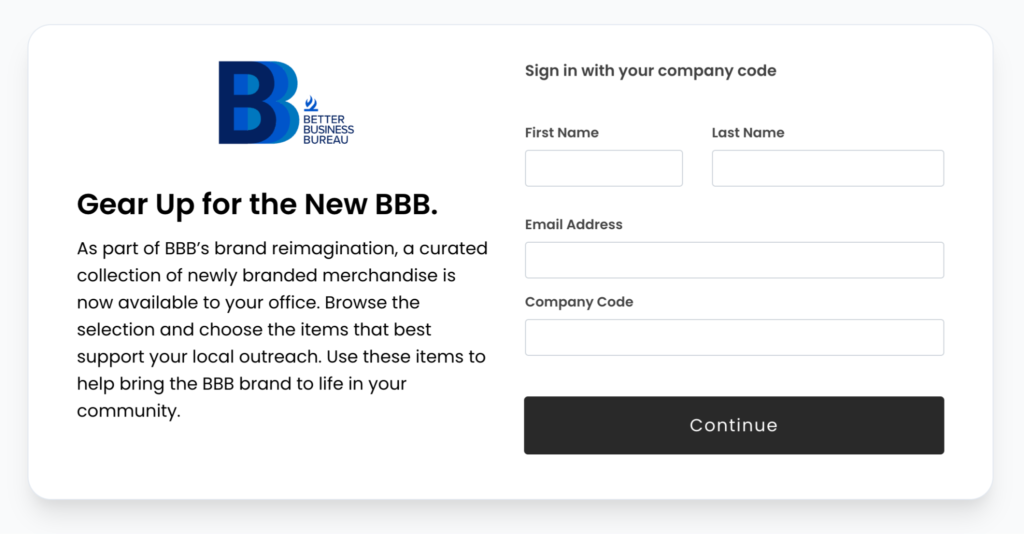
“As part of BBB’s brand reimagination, a curated collection of newly branded merchandise is now available to your office. Browse the selection and choose the items that best support your local outreach.”
— Better Business Bureau, On-Demand Company Swag Store (powered by SwagDrop), 2026 North American rebrand, serving 100+ offices across the United States and Canada.
The BBB program represent SwagDrop’s client scale. One store. Employee choice. In-country fulfillment. No inventory guessing. No cross-border duty exposure.
The Power of the Invite Link
We build programs around the reality that the invite link is the true gift moment. By sending employees to a SwagDrop-managed store, you give them the premium experience of choice. They pick what they actually want to wear or use, ensuring your budget is spent on items that will be valued, not discarded.
In-Country Fulfillment by Default
SwagDrop routes US orders to US facilities and Canadian orders to Canadian facilities. This model is designed to prevent the most common cross-border failures. By producing and shipping domestically, we ensure your Canadian employees never receive a surprise duty bill, delivering a consistent, premium experience across North America.
Opinionated Guidance from 30+ Years of Experience
SwagDrop provides more than just execution; we offer opinionated guidance. With over 30 years of experience in branded merchandise, we tell you what works and what doesn’t. We know which items actually get utilized, how to structure your catalog to offer meaningful variety without overwhelming the user, and how to operate a program that employees actually look forward to.
By shifting to an on-demand, domestically fulfilled store model, SwagDrop allows HR teams to stop guessing what employees want and start delivering a swag experience that actually lands.
The goal is to shift undeliverable failures from a structural feature of the program to an exceptional edge case. At the scale we operate — programs for companies with several hundred to several thousand employees — that distinction matters in ways that show up in the data.
If you’d like to stress-test your current program design, we can walk you through it in a 20-minute call and show you how a store-based, claim-driven model would change your undeliverable rates and spend.