


As large teams of 500 to 5,000 employees become increasingly distributed across the US and Canada, the logistical strain of managing physical merchandise forces a necessary turning point. When deciding between on-demand vs bulk inventory, HR leaders must choose whether to continue stockpiling goods or shift to a more efficient operational framework.
Understanding the structural differences between these two approaches is critical to preventing another year of wasted budget and logistical frustration.
Bulk Inventory Model & On-Demand Alternative
The traditional corporate gifting model is built entirely around inventory. When a company decides to launch a program, they approach it with a procurement mindset, determining they need tens of thousands of dollars worth of physical goods upfront.
This bulk inventory model requires HR to forecast sizes, colors and quantities for the entire company. The organization issues a massive purchase order, pays for the goods, pays for inbound freight, and then takes on the burden of warehousing the items.
In On-Demand model, there is no bulk purchase order. Nothing sits in a warehouse. Instead, the company curates an approved catalog of high-quality items. Employees receive an invite link to an internal store, select the specific item they want, choose their exact size, and provide their current shipping address.
Only after the employee checks out does the item go into production. This employee-choice model shifts the entire dynamic from managing physical stock to managing a digital experience.
6 Operational Differences HR Teams Must Know
If your organization is evaluating which model to deploy for next year’s programs, here are the six core operational differences you need to consider.
| Bulk Inventory Model | On-Demand Swag Model |
| Buy thousands of items upfront | Produce only after employees redeem |
| Guess sizes, colors & quantities | Every item matches the exact size chosen |
| Requires storage, handling, and packing | Zero storage; no physical inventory |
| HR must ship everything manually | Vendor ships directly to each employee |
| Cross-border shipping triggers duties | Domestic fulfillment avoids duties entirely |
| High risk of outdated or unused swag | Catalog updates instantly with no waste |
When the Better Business Bureau rebranded in 2026 across more than 100 offices in North America, SwagDrop managed the on-demand rollout — zero obsolete inventory, logo updates applied digitally, and Canadian employees never received a customs bill. For distributed Canada/US workforces, we route orders domestically by default.
1. Budget Deployment: Sunk Cost vs. Claim-Based
With a bulk inventory model, 100% of the capital is deployed upfront. If an employee never claims their gift, or if a specific size is under-utilized, that money is permanently lost to dead stock. An on-demand model operates on a claim-based budget. You set a per-employee allowance, but the company only pays when an employee actively redeems an item. Unclaimed budgets remain in the company’s bank account.
Employee data backs the demand for this model directly.
SwagDrop’s 2026 Employee Swag & Choice Gap Study (Pollfish, n=1,000 Canadian employees, 250+ employee companies, May 2026) found that when given three options, 78.6% of employees preferred to choose their own item from a curated selection, 16.1% preferred a company-chosen item, and 5.3% said they would rather receive nothing at all than a generic branded item. This is the first time the opt-out question has been asked in any branded merchandise survey in the Canadian market. No comparable competitor study — including Snappy’s 2025 US Holiday Gifting Survey or the ASI 2023 Ad Impressions Study — has offered employees this option.
2. The Sizing Dilemma: Guesswork vs. Precision
Forecasting apparel sizes for a diverse workforce of a thousand people is impossible to get perfectly right, resulting in high donation-bin rates. An on-demand model eliminates forecasting entirely. Because production only happens after the employee inputs their selection, every single apparel item manufactured is guaranteed to be the correct size for the recipient.
The miss rate is systemic, not occasional — and employees are now on record saying so.
According to SwagDrop’s 2026 Employee Swag & Choice Gap Study — a Pollfish survey of 1,000 Canadian employees at companies with 250 or more employees, fielded May 2026 — nearly 3 in 4 employees (73.7%) said the last piece of branded merchandise they received from their employer did not match what they would have chosen for themselves. The most common failure mode was not poor quality but mismatch: 33.4% liked the item but would not have chosen it themselves, and 25.2% said they already owned something similar — wasted spend on redundant items. The study is the first large-scale Canadian dataset to measure the employee experience of corporate branded merchandise programs from the recipient’s perspective.
“Nearly three-quarters of employees at large Canadian organizations say their last piece of company swag missed the mark — not because it was poor quality, but because someone else made the choice for them.”
— SwagDrop Employee Swag & Choice Gap Study, Canada, n=1,000, May 2026
3. Logistics and Storage: Warehousing vs. Zero Footprint
Bulk inventory forces the company—or a highly paid 3PL—to act as a fulfillment center, managing the picking, packing, and shipping of individual boxes. Store-based on-demand systems bypass this completely. The vendor produces the item and ships it directly to the employee’s home address, requiring zero warehouse footprint from the client.
4. The Cross-Border Experience: Customs Traps vs. Domestic Fulfillment
Shipping pre-purchased inventory from a US hub into Canada guarantees that packages will be stopped at customs. Canadian employees are frequently forced to pay duties at the door just to receive their gift. A proper on-demand program routes Canadian orders to Canadian production facilities, ensuring the item is produced and shipped domestically, bypassing international borders entirely.
5. Administrative Tracking: Spreadsheets vs. Automated Reporting
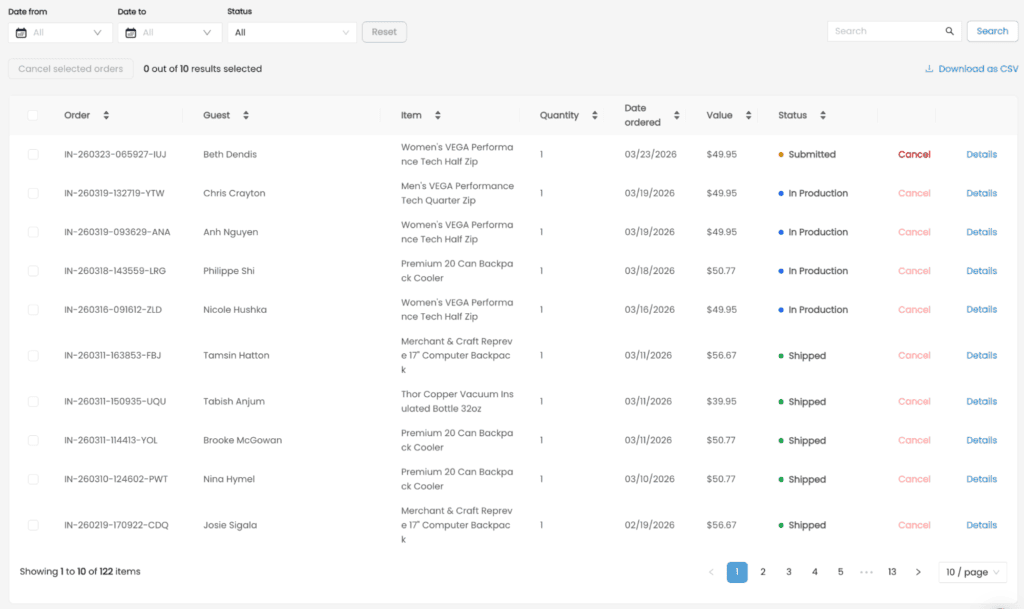
Managing a bulk inventory program requires HR to manually collect addresses via Google Forms, track remaining stock levels, and match tracking numbers to individual employees in massive spreadsheets. An on-demand, store-based model automatically tracks redemptions, sizes, and shipping statuses in real time, virtually eliminating manual administrative work.
6. Obsolescence Risk: Wasted Stock vs. Dynamic Catalogs
When a rebrand hits, it’s stressful enough without an inventory problem on top of it. In an on-demand model, your merchandise is always current. Items are produced at the moment of redemption, so a logo update is as simple as swapping a digital file. No obsolete stock, no write-offs, no awkward decisions about what to do with 2,000 shirts that are already out of date, and no temptation to keep using old branded items and create confusion in the marketplace.
When Each Model Makes Sense
Bulk Inventory Works Only If:
- Your workforce is mainly centralized
- You already stock inventory for retail operations
- Every employee receives the exact same item
- You have storage and shipping staff internally or a 3PL contract.
On-Demand Works When:
- Your workforce is distributed or hybrid
- You want to eliminate size guessing
- HR cannot run logistics manually
- You need US + Canada fulfillment without duties
- You want zero waste and zero storage
Bulk vs On-Demand: Decision Scorecard
| Factor | Bulk Inventory | On-Demand |
| Upfront cost | Very high | None |
| Waste risk | High | None |
| Employee choice | None | Full choice |
| Size accuracy | Low | Perfect |
| Storage required | Yes | No |
| HR admin load | Heavy | Minimal |
| Cross-border issues | Duties & delays | None (domestic routing) |
| Brand agility | Low (inventory locks you in) | High (instant updates) |
If you continue with bulk inventory at scale, these are the failure points that appear early:
- Sizing mismatches –> piles of unusable apparel
- Cross-border duties –> frustrated Canadian employees
- Manual shipping bottlenecks –> HR becomes the warehouse
- Obsolete inventory –> logo changes kill thousands in stock
- Storage constraints –> paid warehouse space for dead stock
- Budget leakage –> 20-40% of inventory goes unclaimed
These failures disappear entirely in an on-demand system.
What to Look for in a Modern Swag Vendor
To successfully implement an on-demand program, you cannot rely on a traditional promotional products vendor whose business model is built on bulk only. You should expect the following capabilities:
- Store-Based Workflows: The vendor must provide the digital storefront infrastructure where employees can browse and redeem credits without HR managing spreadsheets.
- True On-Demand Capability: The ability to produce items one by one as orders flow in, without forcing the client to underwrite minimum inventory thresholds.
- Direct-to-Employee Shipping: Seamless integration between the storefront, the production floor, and the final mile carrier to deliver straight to residential addresses.
- In-Country Fulfillment: Confirmed domestic production networks in both the US and Canada to protect the recipient experience.
How SwagDrop Runs On-Demand Programs
Most of our clients say the same thing on the first call: please don’t make me learn another platform. They don’t have to.
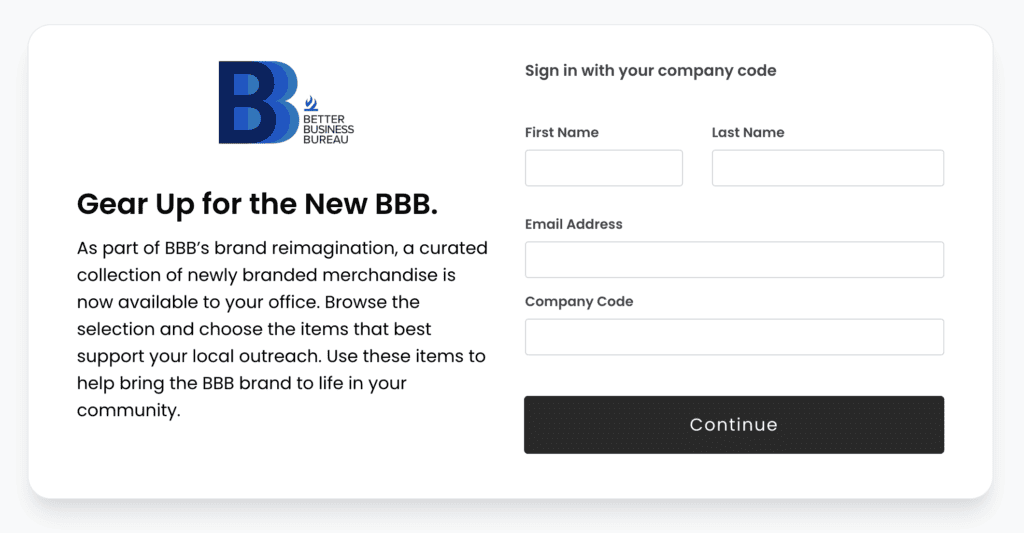
As part of BBB’s brand reimagination, a curated collection of newly branded merchandise is now available to your office. Browse the selection and choose the items that best support your local outreach.” — Better Business Bureau, On-Demand Company Swag Store (powered by SwagDrop), 2026 North American rebrand, serving 100+ offices across the United States and Canada. The BBB rollout produced zero obsolete inventory, instant digital logo updates across all catalog items, and no cross-border duty charges for Canadian offices — outcomes that are structurally impossible under a bulk inventory model.
SwagDrop runs a fully managed, white-glove program that handles everything — store setup, product curation, order management, and direct fulfillment to every employee’s door. For companies with 500 to 5,000 employees, it means a fully running branded merchandise program without adding a single task to anyone’s to-do list.
You Define the Program, We Run the Operations
Clients set the audience, budget, and program goals. We do not hand you a software license and expect you to figure it out. SwagDrop builds the store, configures the curated product catalog, and completely manages the production and direct-to-employee shipping logistics.
Opinionated Guidance from 30+ Years of Experience
We bring over three decades of experience in branded merchandise to every program. We offer opinionated guidance on what works and what fails. We advise our clients on how to structure their catalogs for on-demand success and ensure they select high-quality items that employees will genuinely value, rather than generic filler.
In-Country Fulfillment by Default
To solve the cross-border logistics nightmare, SwagDrop ensures that US employee orders are fulfilled by US facilities, and Canadian employee orders are fulfilled by Canadian facilities. This strict adherence to domestic fulfillment means your Canadian team members receive a premium, duty-free experience every time.
On a Concluding Note
Choosing between an inventory-heavy approach and an on-demand framework will define the operational success of your corporate gifting for the entire year. Shifting away from bulk inventory and embracing an employee-choice, store-based model ensures your team gets exactly what they want, in the right size, without turning your HR department into a logistics and warehousing operation.