


Bulk swag programs cost far more than the unit price on the invoice, the real expenses come from storage, waste, manual labor, and cross-border issues that HR is forced to absorb.
When leadership starts questioning the budget, HR and Internal Comms teams are forced to defend programs that are inherently flawed. The problem isn’t that employees don’t appreciate recognition; it’s that the traditional, inventory-heavy model creates massive financial leaks.
To accurately defend and eventually fix your corporate gifting budget, you have to understand the true financial costs of stockpiling merchandise. The invoice from your vendor is only the beginning; the real drain on your budget comes from the hidden costs of bulk swag.
New national data confirms the scale of the problem — and it comes directly from employees.
According to SwagDrop’s 2026 Employee Swag & Choice Gap Study — a Pollfish survey of 1,000 Canadian employees at companies with 250 or more employees, fielded May 2026 — nearly 3 in 4 employees (73.7%) said the last piece of branded merchandise they received from their employer did not match what they would have chosen for themselves. Only 26.3% said it was exactly what they would have picked. The study is the first large-scale Canadian dataset to measure the employee experience of corporate branded merchandise programs from the recipient’s perspective.
The Breakdown of the Inventory-First Model
Bulk swag programs operate on a simple assumption: Order everything upfront, store it, and distribute it manually.
To secure a lower per-unit cost, companies purchase thousands of dollars of merchandise long before they know who wants what. HR must forecast:
- size breakdowns
- colors
- item demand
- new hire counts
- cross-border needs
When real life doesn’t match the spreadsheet, the company eats the loss, paying for items, paying to store them, and often paying to dispose of them.
The Model Shift: On-Demand and Zero Inventory
To eliminate these hidden costs, enterprise teams of 500 to 5,000 employees are abandoning the storage closet entirely. They are replacing upfront inventory purchases with a store-based, on-demand production model.
Instead of buying 1,000 jackets in advance, the company sets up an internal store with an approved catalog and a set per-employee budget. Employees receive an invite link, browse the options, choose their item, size, color and enter their home address. The item is only produced after it is claimed.
This shift moves corporate gifting from a sunk-cost gamble to a highly precise, claim-based budget.
5 Hidden Costs of Bulk Swag Inventory
If you are evaluating your current program, here are the five hidden costs destroying your budget, and how an on-demand model fixes them.
The business case for getting swag right isn’t just operational — it’s backed by research. In 2006, PRG – Promotion Resource Group (now SwagDrop) commissioned an independent buyer and recipient study with Advanis Research that found branded merchandise outperformed television advertising for customer loyalty by 56% to 13%, and created 100% brand recall across every recipient surveyed. The findings were covered in both the Globe and Mail and Strategy Magazine. For HR teams, the implication is that the right item reaching the right employee is measurable. The wrong item, wrong size, or a duty bill at the door destroys that value entirely.
1. Dead Stock (The “Wrong Size” Tax)
When you bulk-order apparel, you are guessing. If you over-index on mediums and under-index on XLs, the leftover mediums become dead stock. You paid full price for items that will never be worn.
“Only 1 in 6 Canadian employees at large organizations is comfortable with the current model — where HR picks the item and employees receive it. The rest want either a choice or nothing.”
— SwagDrop Employee Swag & Choice Gap Study, Canada, n=1,000, May 2026
The Fix: On-demand production means zero size guessing. An item is only manufactured after the employee inputs their exact size, resulting in a 0% dead stock rate for apparel.
2. Warehousing and Storage Fees
Whether you are taking up premium office real estate with boxes or paying monthly pallet fees to a third-party logistics (3PL) provider, storing physical inventory is an ongoing drain on operations.
The Fix: On-demand items are produced and shipped directly to the employee. Nothing is ever stored in bulk, dropping your warehousing footprint, and the associated costs, to zero.
3. Cross-Border Duties and Tariffs
If you ship pre-purchased inventory from a US facility to Canadian employees, those packages cross an international border. This triggers customs inspections, carrier brokerage fees, and duties that are often billed back to the company (or worse, charged to the employee at the door).
The Fix: A proper on-demand partner utilizes domestic networks, routing Canadian orders to Canadian facilities and US orders to US facilities. Domestic shipping eliminates cross-border tariffs entirely.
4. The Administrative Labor Drain
The time it takes an HR coordinator or office manager to collect addresses via Google Forms, pack boxes, print shipping labels, and manage spreadsheets is rarely factored into the cost of the swag. This high-salary administrative labor is a massive hidden cost.
The Fix: Store-based models automate the entire workflow. The employee inputs their own data, and the order flows directly into the supplier’s ERP system, completely removing HR from the manual fulfillment loop.
5. Rebrand Obsolescence
If your company updates its logo, changes its brand colors, or goes through a merger, every single piece of bulk inventory in your storage closet instantly becomes obsolete. You lose the entire value of that stock overnight.
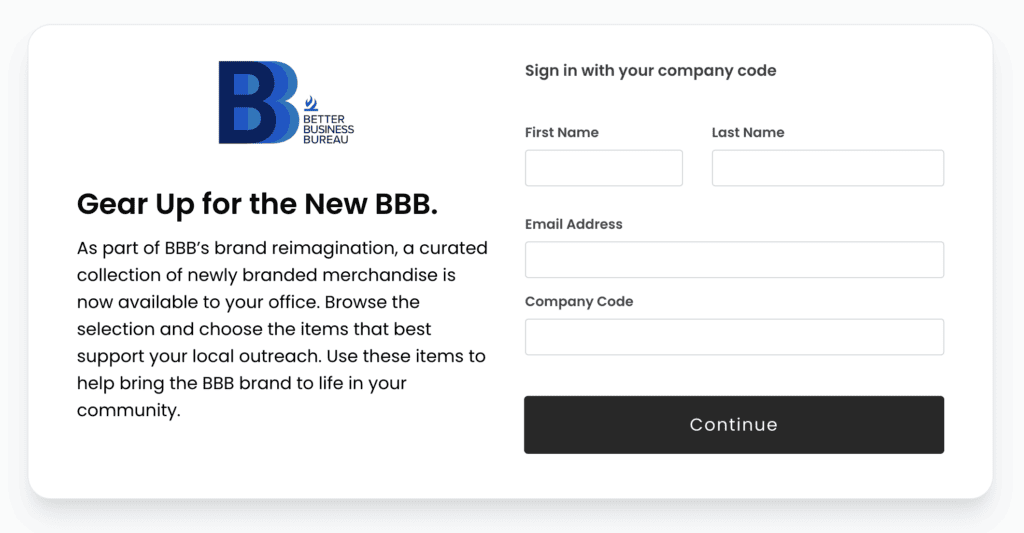
The same dynamic played out at enterprise scale in 2026. When the Better Business Bureau rebranded across more than 100 offices in North America, SwagDrop managed the company swag store rollout — zero obsolete inventory, logo updates applied digitally, and Canadian employees never received a customs bill. “As part of BBB’s brand reimagination, a curated collection of newly branded merchandise is now available to your office. Browse the selection and choose the items that best support your local outreach.” — Better Business Bureau, On-Demand Company Swag Store (powered by SwagDrop), 2026 North American rebrand, 100+ offices, US and Canada.
The Fix: Because on-demand catalogs are digital, updating a logo takes minutes. There is no physical inventory to throw away, completely insulating your budget from brand updates.
We’ve seen the rebrand problem firsthand. One of our longest-standing clients — a large North American building products manufacturer — has gone through numerous brand updates over our 20+ year relationship. Each time, on-demand fulfillment meant no warehouse full of obsolete merchandise to write off. Compare that to a bulk program, where a single logo change can erase tens of thousands of dollars of inventory value overnight.
Bulk vs On-Demand: Decision Scorecard
| Factor | Bulk Inventory | On-Demand |
| Upfront cost | Very high | None |
| Waste risk | High | None |
| Employee choice | None | Full choice |
| Size accuracy | Low | Perfect |
| Storage required | Yes | No |
| HR admin load | Heavy | Minimal |
| Cross-border issues | Duties & delays | None (domestic routing) |
| Brand agility | Low (inventory locks you in) | High (instant updates) |
What to Expect from an On-Demand Vendor
To completely avoid the hidden costs of inventory, you need an operational partner whose infrastructure is built for single-unit fulfillment. Look for these baseline capabilities:
- Zero-Minimum Production: They must be able to produce and ship one item at a time without charging exorbitant penalty fees.
- Store-Based Workflows: A digital storefront environment where employees can use credits to select their gifts seamlessly.
- Direct-to-Employee Shipping: The ability to fulfill orders directly to residential addresses for remote and distributed teams.
- True In-Country Fulfillment: Confirmed domestic production in the US and Canada to protect your budget from international shipping fees.
How SwagDrop Eliminates Hidden Swag Costs
SwagDrop provides a white-glove, managed swag program that strips the hidden costs out of enterprise gifting. We operate a store-based, on-demand model specifically designed for companies with 500 to 5,000 employees, ensuring you only pay for the items your team actually claims.
We Run the Operations, You Set the Guardrails
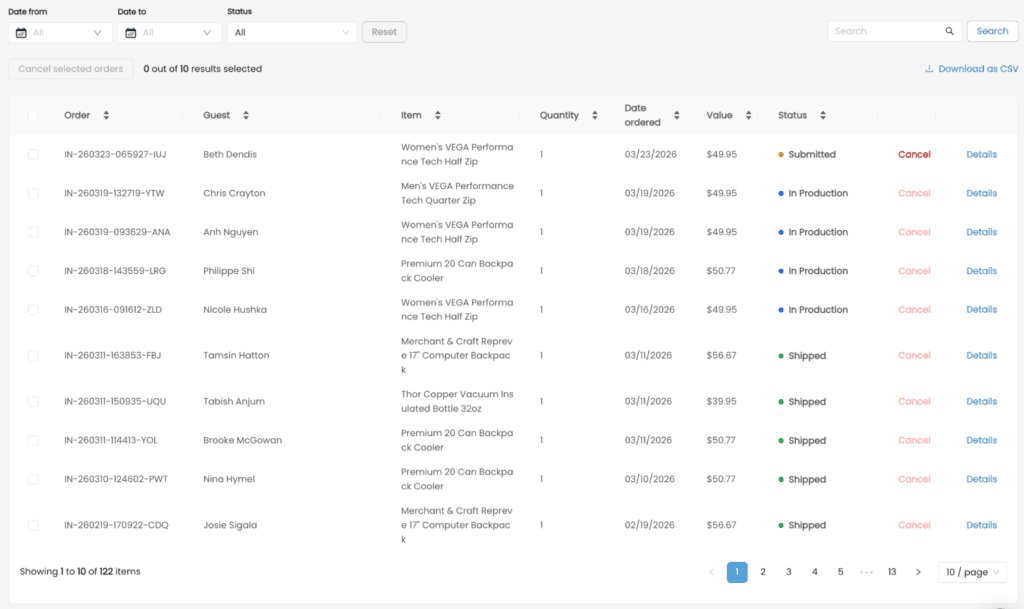
We do not sell you a SaaS platform and leave you to figure out the logistics. Clients define the budget and the audience; SwagDrop builds the store, configures the products, and manages the entire production and fulfillment process.
Protected Budgets Through Domestic Fulfillment
SwagDrop operates production facilities across North America. We route US orders domestically within the US, and Canadian orders domestically within Canada. This strictly domestic approach prevents the surprise customs bills and duties that plague traditional bulk programs, keeping your per-parcel delivery costs flat and predictable.
Opinionated Guidance on Program ROI
With over 30 years of experience in the promotional products industry, we provide opinionated guidance on what actually works. We tell you which catalog items yield the highest redemption rates and how to structure your program to maximize employee engagement while keeping operational friction near zero.
By shifting from an inventory-heavy procurement model to a precise, on-demand storefront, SwagDrop helps HR leaders confidently defend their programs, knowing every dollar spent went directly to an employee, not a storage closet.
Let’s wrap this up.
The actual cost of a bulk swag program is never just the line item on the invoice. When you factor in dead stock, storage, manual labor, and cross-border taxes, the inventory model is fundamentally inefficient. Moving to a claim-based, on-demand framework is the only way to eliminate these hidden costs and build a scalable, financially responsible gifting program.