


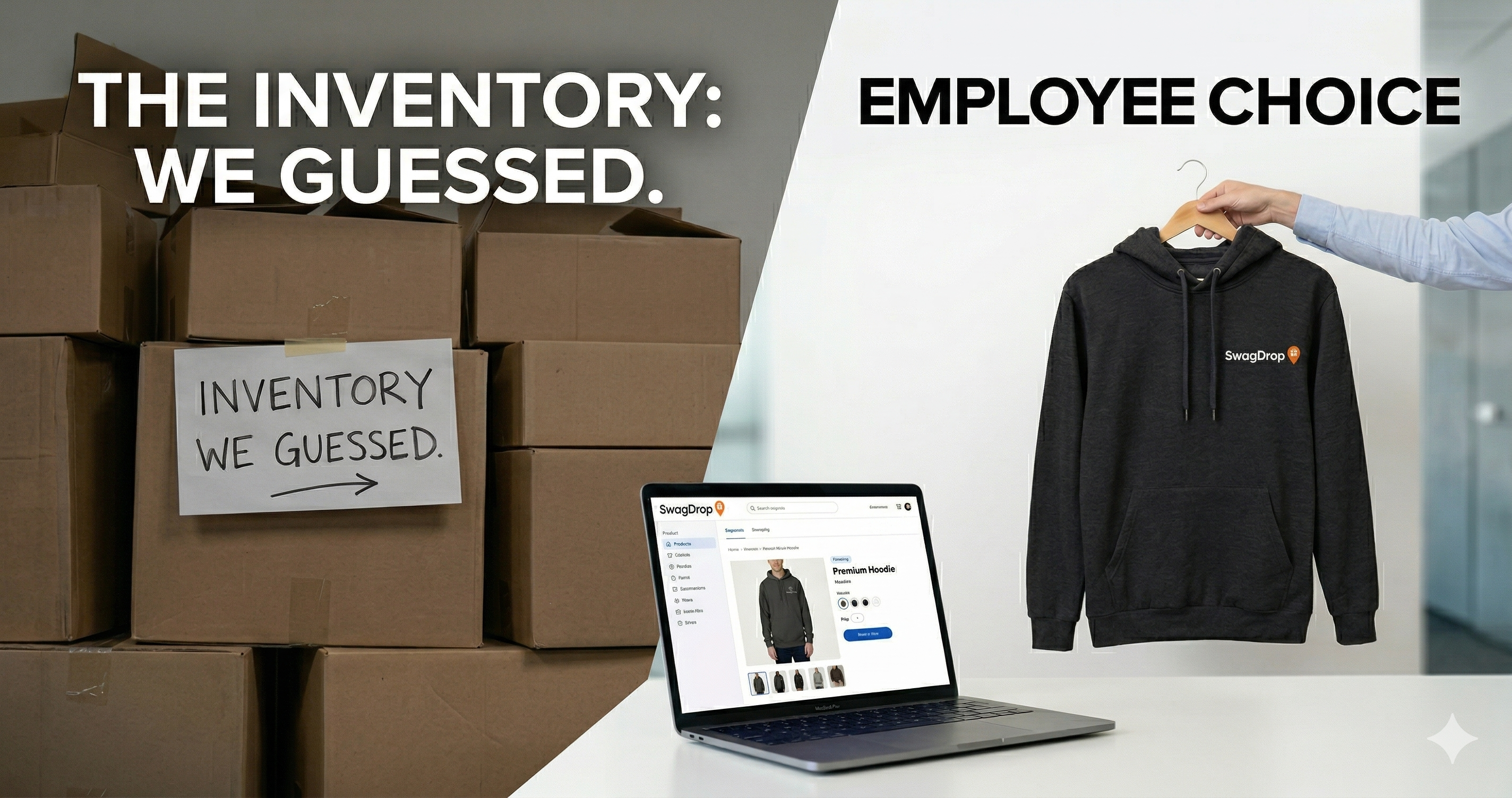
When a company is small, swag is simple. A few shelves of apparel, a single office closet, and a predictable flow of new hires make it easy to keep track of what exists and how quickly it’s used.
But as an organization grows, especially into the 500–5,000?employee range, that simplicity disappears. What used to feel like a light administrative task quietly becomes a full operational system: multiple locations holding their own stock, inconsistent size curves, leftover items from past programs, and employees in different regions needing different distribution methods.
This shift isn’t due to poor management or lack of effort. It’s a sign that the internal swag system the company relied on simply didn’t scale with the organization.
If your team is managing boxes, closets, spreadsheets, or inconsistent stock across offices, you’re already experiencing the early failures of an outdated system.
The Real Problem: Your Swag System Didn’t Scale
As a company expands, demand for branded merchandise expands with it:
- more hiring
- more teams
- more offices
- more recognition moments
- more campaigns
- more distributed employees
But the internal structure supporting swag often stays exactly the same:
- a spreadsheet
- a single ordering cycle
- a few people informally “in charge”
- leftover items stored wherever space exists
- ad hoc replenishment whenever something runs out
Swag stops being a purchasing exercise and becomes an operational workflow — without anyone explicitly rebuilding that workflow to match the organization’s new complexity.
Several common triggers cause the system to break:
Rapid headcount growth
The swag setup that worked at 200 employees becomes unmanageable at 1,200.
Multiple offices and regions
Inventory spreads across cities with no centralized visibility.
Remote and distributed employees
Items once distributed in-office now require shipping one-by-one to homes.
Accelerated onboarding cycles
Hiring surges drain certain items unpredictably.
Programs and seasonal campaigns
Demand shifts from predictable reorder cycles to sudden spikes.
None of these triggers are errors.
They are structural signs your swag model didn’t grow with the company.
5 Red Flags Your Swag Inventory System Is Breaking
These operational symptoms show up consistently across scaling organizations. If you recognize even two of them, your swag system is already under stress.
1. Inventory is scattered across different offices with no unified tracking
One office might have dozens of XL shirts, while another is out entirely.
Marketing might have boxes from an old campaign, while People Ops holds leftover onboarding stock.
Without visibility, ordering becomes guesswork — and waste increases.
2. Nobody knows how much inventory actually exists
Teams often discover:
- old boxes containing outdated or off-brand items
- partial kits missing critical pieces
- apparel from past initiatives mixed with current stock
This creates confusion at the exact moment you need consistency.
3. Size curves collapse: Certain sizes run out while others pile up
This is one of the clearest indicators of system failure.
Common patterns:
- no mediums or larges left
- dozens of XS or 3XL that never move
- poor fit for distributed teams with different demographics
Forecasting collapses when multiple locations handle stock independently.
4. HR, People Ops, or Office Managers are doing manual fulfillment
This includes:
- collecting addresses
- packing boxes
- mailing items
- tracking returns
- fixing incorrect orders
- handling cross-border issues
This is not sustainable — and it’s a sign the system has outgrown its original model.
5. Old-logo or outdated items keep resurfacing
Items that should have been retired months ago suddenly show up during onboarding or in office storage.
This is evidence of:
- lack of version control
- no formal retirement process
- poor visibility into what’s stored where
The brand experience becomes inconsistent as a result.
Why Scaling Companies Lose Control of Swag Inventory
Growth introduces complexity that legacy swag processes cannot absorb.
More locations = more fragmentation: Each office starts building its own micro-inventory without intention.
More distributed employees = more one-off shipments: What once worked with in-office distribution becomes a shipping workflow.
More programs = more unpredictable demand: Onboarding, recognition, events, and rebrands now each require swag independently.
More brand changes = more obsolete items: Legacy merchandise becomes outdated faster, creating piles of unusable stock.
How to Fix Swag Inventory Management (6-Step Scalable Approach)
Fixing the problem doesn’t require a massive warehouse cleanup or an intensive audit.
It requires changing how swag is structured.
The scalable model is,
From: Owning inventory, storing it, and distributing it manually
To: Running programs where employees choose from a curated, on-demand catalog — and items are produced only when claimed.
Here’s how to transition effectively.
1. Centralize Inventory Control, Even If You Still Have Stock
Create one source of truth:
- what items exist
- where they live
- which versions are current
- what needs to be retired
This eliminates duplicate orders and reduces waste immediately.
2. Implement Program-Based Demand Forecasting
Instead of:
- guessing quantities
- ordering static sizes
- planning for “the year”
Switch to forecasting based on:
- onboarding cycles
- recognition initiatives
- specific campaigns
- targeted employee groups
Employee-choice programs eliminate the need for SKU-level forecasting entirely.
3. Move Toward SKU-Level Visibility
You don’t need a full warehouse system.
You need to know:
- how many units remain
- which sizes are viable
- which items are in danger of becoming obsolete
- which locations hold which stock
Basic clarity unlocks better decisions.
4. Use a Controlled Warehouse or Fulfillment Hub
This doesn’t have to be outsourced — it can be internal.
What matters is structure:
- consistent intake
- consistent output
- predictable inventory movement
- no “random closet surprises”
Most companies find that once they centralize, waste drops significantly.
5. Standardize Workflows Across the Organization
Define:
- who requests item replenishment
- how approvals happen
- what programs draw from inventory
- how items ship to employees
- how local offices access stock (if they still do)
Standardization reduces ad hoc decisions — and operational stress.
6. Reduce Leftover Inventory Through Employee-Choice Programs
This is the highest-impact shift.
Instead of buying and storing items “just in case,” move to:
- curated catalogs
- per-employee budgets or allowances
- on-demand production
- direct-to-employee shipping
This eliminates:
- forecasting
- storage
- size curve fallout
- cross-office imbalance
Only items that are actually claimed get produced.
If You Already Have a Warehouse (or Closet) Full of Swag
The solution is not:
- “use it up” pressure
- more bulk ordering
- adding shelving
- spreading it across offices
The solution is: stop adding to the pattern.
Do these two things:
1. Pause new bulk orders unless absolutely necessary
Don’t expand the inventory footprint.
2. Shift all new programs into a modern model
Recognition, onboarding, and campaigns should move to:
- store-based distribution
- credits or budgets per employee
- items produced on demand
- direct shipping
This prevents the next cycle of accumulation.
What to Expect from a Vendor When You Want to Move Beyond Bulk
If you’re trying to get out of the inventory business, the vendor you choose matters. At minimum, a good partner should be able to:
- Run on-demand programs without requiring you to hold inventory.
- No obligation to pre-stock core items.
- Ability to handle one-by-one employee orders as programs run.
- Support employee choice within clear budgets.
- Fixed credits per person or by audience.
- Transparent pricing so you can see what each redemption represents.
- Manage direct shipping to employees.
- Home or office addresses.
- Packing and fulfillment handled by them, not by your internal teams.
- Support US and Canada cleanly.
- Production and fulfillment from within each country.
- Programs that work for distributed North American teams without customs surprises.
- Provide practical reporting.
- Participation and redemption rates.
- Spend by program or audience.
- High-level insight into the items people actually choose.
The goal isn’t just to avoid another warehouse. It’s to replace inventory-driven swag with program-driven recognition and engagement that you can explain and repeat.
How SwagDrop Helps Companies Move Beyond Bulk and Warehousing
Many of the teams SwagDrop works with reach the same point: a warehouse or storage room full of past swag decisions, and a growing sense that bulk ordering doesn’t fit how their company now operates.
SwagDrop doesn’t come in to run inventory audits or manage your existing stock. Instead, the focus is on stopping the pattern and shifting new initiatives into a better model. That begins with understanding your core programs; onboarding, recognition, campaigns, events; and reshaping them around employee-driven stores and on-demand production.
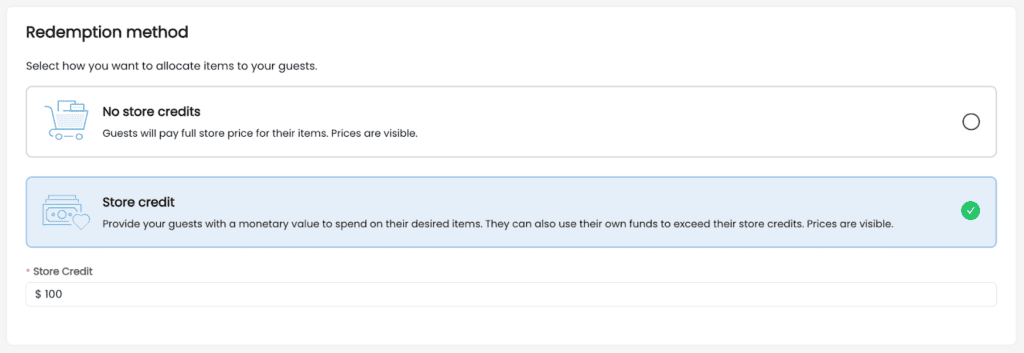
From there, SwagDrop sets up store-based programs where employees can receive a link and a credit instead of a pre-selected item. They choose from a curated catalog that reflects your current brand and priorities. Orders are produced when they’re placed and shipped directly to each employee, which means you’re no longer buying, storing, and managing pallets of swag “just in case.”
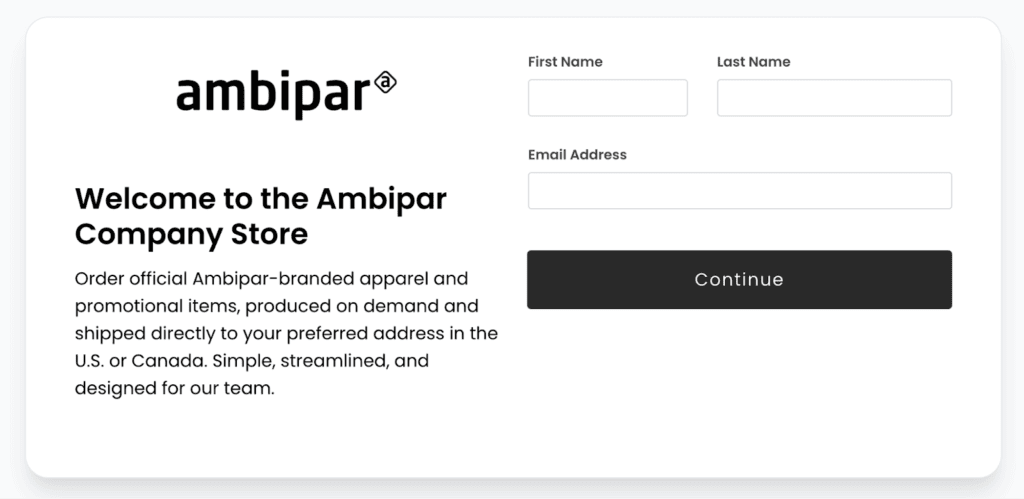
Operationally, SwagDrop runs the mechanics for you:
- Program and store setup based on your audience and budget.
- Uploading eligible employee lists.
- Assigning budgets or credits per person.
- Routing orders into production as employees redeem.
- Fulfilling from within the US for US teams and within Canada for Canadian teams, avoiding cross-border friction.
Underpinning this is 30+ years of experience in promotional products and corporate swag. That experience shows up in the guidance you get on catalog breadth, product selection, and how to design recognition and engagement programs that don’t depend on a warehouse full of guesses.
Instead of expanding storage, you move toward programs that only generate swag when someone actually claims it; and a model that scales with your company without filling another storage unit.
Future-Proofing Your Swag System
Once the system is upgraded, the company stops running one-off swag “projects” and starts running repeatable programs.
That means:
- onboarding becomes automatic
- recognition becomes repeatable
- brand consistency improves
- storage disappears
- items match employee preferences
- old inventory no longer accumulates
- HR stops doing manual labor
- remote teams stay included
Your swag system finally scales with your company instead of collapsing under it.
FAQs
Why does swag inventory become harder to manage as we grow?
Growth introduces complexity that legacy processes cannot absorb: more locations, more distributed employees, more recognition moments, and larger onboarding cycles. Inventory models built for small teams don’t expand smoothly into multi-office, multi-region environments. The challenges aren’t due to poor management; they are structural.
What is the most common cause of leftover or unused swag?
Leftover swag usually comes from forecasting-based ordering—guessing sizes, quantities, and preferences months in advance. As teams become more distributed and programs evolve, those assumptions break down. Employee-choice programs eliminate the need to forecast sizes or styles, which dramatically reduces leftovers.
How does shifting to employee-choice programs improve the experience?
Employees select items they actually want, in the correct size and style. This eliminates size-curve issues, reduces waste, and ensures more consistent brand alignment across distributed teams. It also removes the need for internal forecasting, storage, and distribution.