


The executive offsite went well.
Everyone agreed: the company needs a visible way to thank employees for a tough year and reconnect people after a lot of change.
In the next all-hands, the announcement drops: “On [date], everyone will be receiving a special gift as a thank you for everything you’ve done.”
The chat loves it. Screenshots hit Slack. The date is now public.
And in HR, People Ops, or Internal Comms, someone is thinking:
- “We don’t have a program for this.”
- “We don’t even have current addresses for everyone.”
- “Our swag vendor’s lead time is 4-6 weeks.”
- “How are we supposed to send company-wide employee gifts on a fixed executive deadline without chaos?”
This is a classic leadership promise crisis: the intent is generous; the operational plan is undefined.
The good news: this is solvable – even on a tight timeline. Teams deliver on fixed dates all the time, especially when they stop treating it like a one-off scramble and start treating it like a timed, company-wide logistics program.
Crucially, the “gift” doesn’t have to be physically in every employee’s hands on that date. The real promise is kept when:
- the store is live,
- the budget is loaded, and
- the link is in employees’ inboxes.
At that moment, the gift has effectively been delivered; the physical items follow on normal shipping timelines.
SwagDrop has spent 30+ years running corporate swag and gift programs across Canada and the US, including many “we have 2-3 weeks, can you help?” scenarios. The patterns are repeatable, and so is the path out.
Why a “Nice Gesture” Turns Into a Logistics Fire Drill
From the executive team’s perspective, setting a fixed date feels clear and motivating:
- It gives employees something to look forward to.
- It signals commitment to appreciation.
- It creates urgency internally.
From HR’s perspective, that single sentence quietly commits the company to:
- Company-wide coverage – “everyone” means all employees, across locations.
- A visible, fixed moment – people will remember the date.
- A standard of fairness – the experience should feel consistent.
- An expectation of quality – the gift reflects how much leadership values people.
Without a scalable model, the fallback options are:
- collecting addresses manually
- placing a massive bulk order and hoping it ships on time
- shipping box by box from HQ
That can work for 40 people in one office. For a hybrid, distributed, or cross-border workforce, it’s a recipe for late arrivals, missed employees, and burnt-out HR.
The Hidden Fine Print in That Executive Promise
When leadership gives a fixed gift date in front of staff, they are implicitly promising:
- Everyone who’s meant to be included actually gets something.
- The timing feels connected to the date they said.
- The process doesn’t derail every other HR priority for weeks.
The real challenge is this: How do you send company-wide employee gifts on a fixed executive deadline without turning HR and office managers into a short-term shipping department?
And again: the key is to treat “the date” as the moment when the store link and budget land in employees’ hands – not the moment every box lands on every doorstep.
That’s what this compressed timeline and logistics guide is designed to solve.
The Constraints You’re Fighting Against (You’re Not Alone)
Most teams facing this scenario are dealing with the same limitations:
- Hybrid or distributed workforce: Some people are in offices; many are remote or in other regions/countries.
- Partial or stale address data: HRIS addresses are incomplete; some employees have never provided a home address.
- Bulk-only swag vendors: Existing vendors are set up to ship pallets to one address, not gifts to hundreds of homes.
- Limited internal capacity: HR and office managers do not have spare time to run an in-house fulfillment operation.
What a Strong Swag Partner Brings to This Chaos
At this stage, a strong swag partner should be able to say:
- “Yes, we can launch a store in 1-2 weeks with your budget and catalog loaded.”
- “We can ship directly to employees, not just to offices.”
- “We can run this as an on-demand program, not a pay-and-pray bulk order.”
- “We support US and Canadian fulfillment without dumping duty surprises on employees.”
- “We collect addresses and sizes as part of the order, so you’re not chasing spreadsheets.”
If a vendor’s only plan is, “Place a huge order and we’ll ship it to HQ,” you already know who will be doing the hard work – and it won’t be them.
The 6-Phase Plan (for a 2-3 Week Window) to Hit a Fixed Gift Date
Most SwagDrop clients don’t show up with months to spare. They typically arrive with about two weeks between the executive promise and the target date. Here’s how to make that work.
Phase 1 (Days 0-1): Stop the Guessing – Get the Promise on Paper
Before you talk about what to send, lock down what was actually promised.
- Who’s included? Full-time only, or also part-time, contractors, people on leave?
- Where are they? Countries/regions, major clusters.
- What does “on [date]” really mean? Is leadership okay with:
- Store and link live by that date (the gift is “delivered”),
- with physical items arriving over the following days/weeks?
- What’s the per-person budget? You need a real number to design around.
- What’s the minimum viable experience? One solid, meaningful gift for everyone – chosen by them – beats an elaborate kit that arrives late or only reaches some groups.
This conversation is where HR protects the team from an impossible brief and resets expectations around what “delivered by [date]” actually means.
Phase 2 (Days 1-3): Design the Program, Then the Gift
Most chaos comes from skipping this step.
Focus first on how the program will work:
- Audience segmentation
- Who can realistically receive items at an office?
- Who must be reached at home?
- Fulfillment approach
- Office-based clusters might still use local distribution for some items.
- Remote and cross-border staff need direct-to-home deliveries.
- Program shape
- One per-employee budget loaded into the store.
- A small catalog (3-5 options) for employees to choose from.
- A clear call to action: “On [date], you’ll receive a link to choose your gift within this budget.”
The simpler the structure, the more likely you are to launch on time.
Phase 3 (Days 3-7): Build the Rails So HR Isn’t the Router
This is where you either create a scalable flow or commit to spreadsheet misery.
A future-proof setup includes:
- A central ordering link/portal instead of email replies.
- Built-in address and size collection when someone chooses a gift.
- Direct-to-employee shipping for remote and cross-border employees.
- Tracking and issue handling in one place.
What a Strong Swag Partner Does at This Point
A modern swag partner should:
- Spin up a program-specific store quickly with your budget and catalog.
- Collect shipping details and sizes as part of the checkout flow.
- Validate addresses (including US and Canadian formats).
- Ensure individual orders get an email confirmation and shipment notification.
- Commit to a store launch window that aligns with your executive date.
- Provide program-level reporting, so you can see who ordered and what’s in flight.
In a white-glove model, the partner handles this setup. Your team defines the rules; they handle the mechanics.
If you’re manually exporting form responses and uploading CSVs into a shipping tool, the partner is not doing enough of the work.
Phase 4 (Days 7-10): Launch the Store Like a Short Internal Campaign
The “gift date” is when employees get access to the store and their budget – that’s the moment the promise is fulfilled.
Key elements:
- Launch message (from HR or an exec):
- Remind people of the original promise.
- Share the why (“thank you,” recognition, shared moment).
- Provide the store link, explain the budget, and state the order-by date.
- Simple instructions:
- “Click this link on/after [date].”
- “Choose one gift within your budget.”
- “Confirm your shipping address and size.”
- Manager prompts:
- Give managers a short blurb to use in team meetings.
- Ask them to remind people to place their orders.
- Delivery expectations:
- “Once you place your order, most gifts will arrive within X-Y business days.”
- “You’ll get tracking once your gift ships.”
On the promised date, employees get control: a budget, a link, and a choice. That’s the real “delivery” moment.
Phase 5 (Days 10-14): Watch the Dashboard, Not Every Order
As orders start coming in, production and fulfillment should start immediately – each order is worked on as soon as the employee submits it, not after some batch cut-off.
Your job in this phase is to steer the program, not the boxes:
- Monitor response rates overall and by region/team.
- Send 1-2 targeted reminders where participation is low.
- Avoid over-customizing for every edge case.
Set and communicate:
- A cut-off date for which orders you can guarantee delivery within your desired window after ordering – even though every user’s order is started as soon as they enter it.
- A simple rule for late responders (e.g., still eligible, but shipping timelines may be longer).
With the right partner, you’re looking at a program dashboard while orders are being produced and shipped in real time – not manually tracking each package yourself.
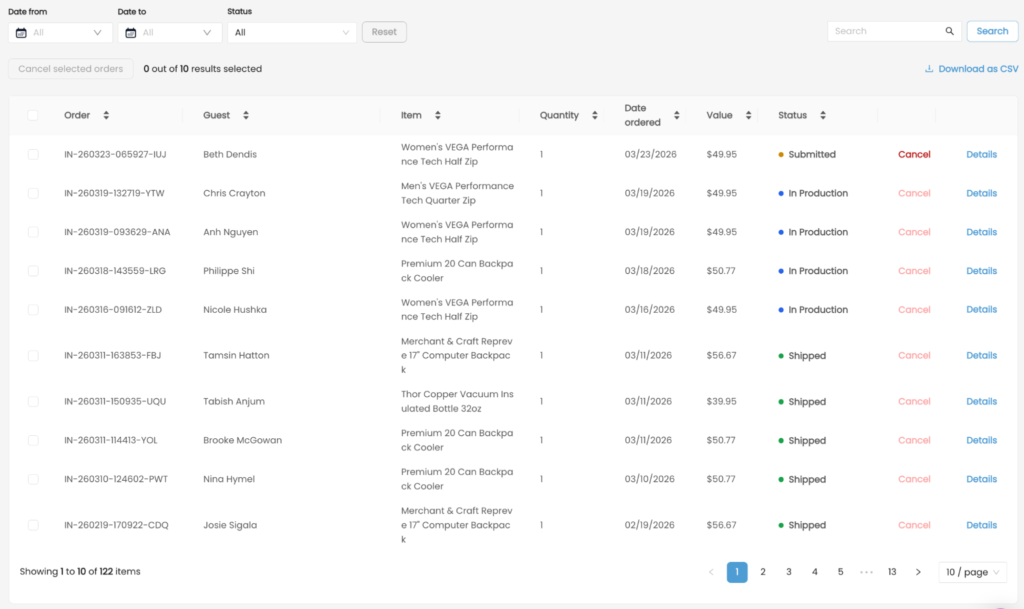
Note: Names are anonymized for example of order dashboard.
Phase 6 (After 2-3 Weeks): Let Fulfillment Run and Capture the Learning
Once the store is live and orders are flowing, your job shifts:
- Keep light-touch comms (“We hope you’re enjoying your gift – thank you again for everything you’ve done.”).
- Let the partner’s fulfillment system handle production, shipping, and tracking.
- Run a quick debrief after the main wave:
- What worked smoothly?
- Where did HR still end up doing manual work?
- What would you adjust next time?
This is how a one-time emergency becomes a repeatable pattern you can reuse the next time leadership sets a fixed date.
Verified Trustpilot Review
“Our company just went through a huge transition with four new brands, six different logos, and countless last-minute orders, and SwagDrop has been there for us every single step of the way. No matter how complex our requests are, they make it easy.”
— Angelica Colantuoni, Orion Steel
SwagDrop: The Partner Behind the “Good Vendor” Playbook
All the “this is what a good swag partner should do” moments above aren’t hypothetical. They describe what SwagDrop has been building and refining through 30+ years of running corporate gift and swag programs.
When leadership sets a date and HR has to make it real, SwagDrop does the heavy lifting so you don’t have to.
SwagDrop helps you:
- Turn the executive promise into a defined program with per-employee budgets and a curated, on-brand catalog.
- Launch a store on a tight timeline, so the link and budget land in employees’ inboxes by the promised date.
- Let employees choose their gift and enter their own shipping details, instead of HR managing forms and spreadsheets.
- Ship directly to employees in Canada and the US using in-country fulfillment to reduce delays and avoid duty surprises.
- Provide tracking and program-level reporting, so you always know who’s been reached and what’s left to do.
In other words, everything this article describes as the mark of a strong swag partner is exactly what SwagDrop does – as a white-glove service, not just a platform.
Leadership will set fixed dates again. With SwagDrop, those dates become just another program you already know how to run, without turning HR into a short-term warehouse.